



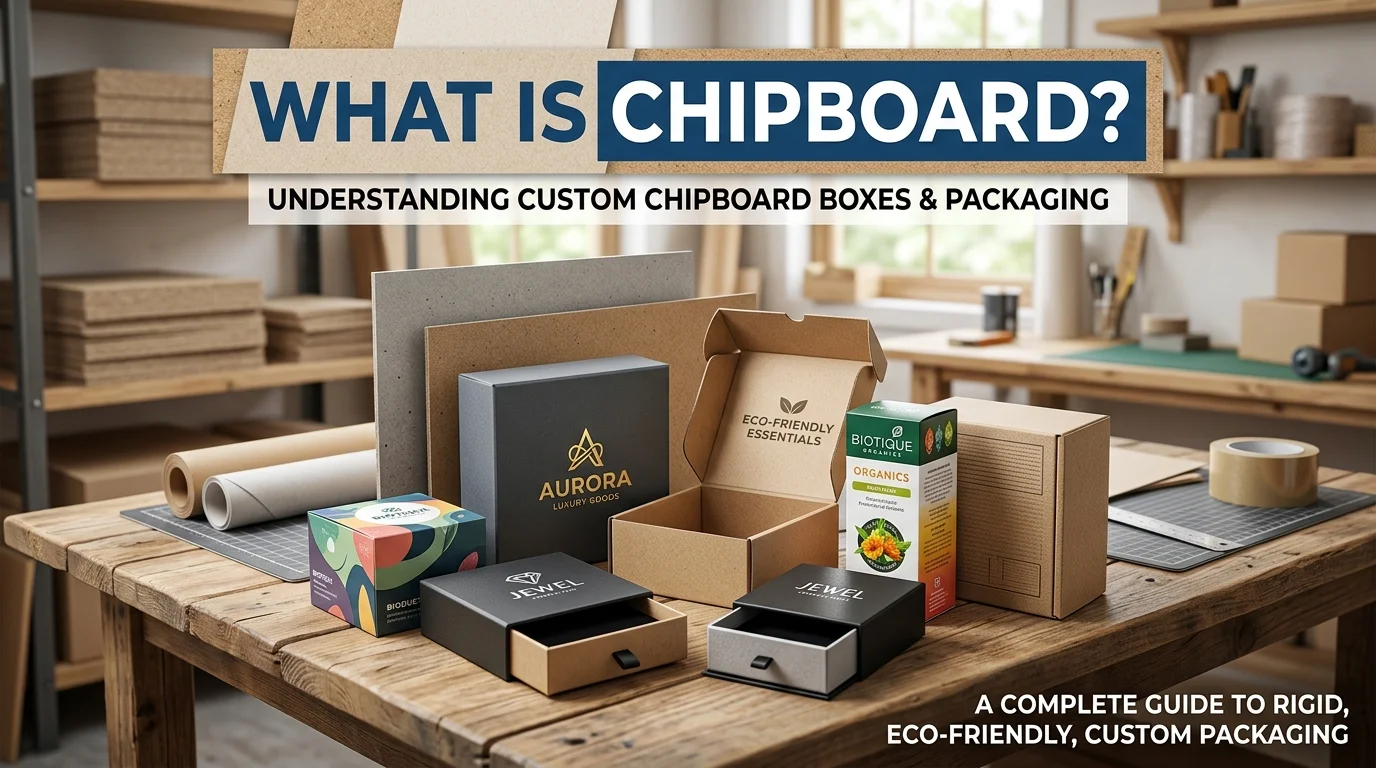
What Is Chipboard? A Complete Guide to Composition, Grades, and Uses
August 17, 2026 Explore Blogs
In packaging, chipboard is a dense, uncoated recycled paperboard made by pulping recovered paper, laying it into thick multi-ply sheets, and pressing them under heat until they bond into a single rigid board. It’s the grey backing board behind notepads, the core layer inside cereal-box liners, and the stiff inner layer laminated under glossy retail packaging. It is not the same material as construction “chipboard” (wood particleboard), a distinction that causes most of the confusion around this term.
This guide separates the two meanings, then breaks packaging chipboard down by composition, manufacturing process, industry grade names, caliper/thickness standards, and where each grade is actually used.
Important: “Chipboard” Means Two Different Materials
Before going further, it’s worth resolving an ambiguity that trips up most searches on this term:
| Term | Industry | Made from | Typical form |
| Chipboard (packaging/paper) | Packaging, bookbinding, printing | Recycled paper fiber, pulped and pressed | Thin rigid sheets (0.008″–0.1″), used for boxes, inserts, book covers |
| Chipboard (wood/construction) | Furniture, flooring, construction, more precisely called particleboard | Wood chips and shavings bonded with resin | Thick structural panels (12–25 mm), used for furniture cores and subflooring |
Both share a name because both are made from compressed wood-derived chips or fiber, but they are engineered for entirely different jobs: one for folding and printing, the other for load-bearing structure. This guide covers packaging chipboard, the material relevant to boxes, inserts, and retail packaging. If you’re researching furniture-grade material, look for “particleboard” or “MDF” instead different fiber size, different resin system, different strength profile.
What Packaging Chipboard Is Made Of
Packaging chipboard is a recycled paperboard: multiple thin layers of pulped, recovered paper fiber pressed and dried together into one thicker sheet. Its composition breaks down into three parts:
1. Recovered Fiber (the base material)
Most chipboards are made almost entirely from post-consumer and post-industrial recycled paper: old newspapers, corrugated box trim, office paper, and printer’s waste rather than fresh wood pulp. This is the main reason chipboard costs less than virgin paperboard grades like SBS (solid bleached sulfate): it draws on lower-cost recovered fiber instead of freshly harvested, chemically bleached wood pulp.
2. Water and Adhesive Binder
The recovered fiber is re-pulped in water, then layered onto a forming wire in several plies. Each wet layer bonds to the next through inter-fiber hydrogen bonding, reinforced by a starch or synthetic binder applied between plies for extra ply-to-ply adhesion, the same bonding chemistry used in corrugated linerboard, just applied in flat layers instead of a fluted structure.
3. Heat and Pressure (not a separate material, but the defining process)
What turns loose recycled fiber into a rigid board is compaction: heated rollers press the wet, multi-ply mat until the fibers interlock and the water is driven out. This is why chipboard feels dense and stiff compared to ordinary paper; it’s structurally a stack of bonded fiber layers, not a single sheet.
Some grades add a functional top layer for appearance or performance:
- Clay/mineral coating for a smooth, printable white surface
- Kraft or bleached liner laminated to one or both faces for a cleaner look
- Wax or polyethylene (PE) film for moisture resistance in food-contact applications
How Chipboard Is Manufactured
- Collection and pulping: Recovered paper is sorted, de-inked if needed, and broken down into fiber slurry in water.
- Screening: Contaminants (staples, plastic film, adhesive residue) are filtered out.
- Sheet forming: the fiber slurry is laid down in multiple plies on a paperboard machine, building thickness layer by layer rather than as one pass.
- Pressing and drying: Heated rollers compact the wet plies and remove moisture, bonding the layers into a single sheet.
- Finishing: Depending on the grade, the board is coated, laminated, cut to sheet or roll size, and calibrated to a target caliper (thickness).
Chipboard Grades: What the Industry Actually Calls Them
“Chipboard” is the everyday term; packaging professionals specify one of these grade names, which is useful vocabulary if you’re sourcing material or reading a supplier spec sheet:
| Industry grade | Common name | Structure | Typical use |
| Uncoated recycled board (URB) | Plain/grey chipboard | Single or multi-ply recycled fiber, uncoated | Book backing, notepad backs, dividers |
| White-lined chipboard (WLC) | Coated chipboard | Bleached white face ply over a recycled grey core | Cereal cartons, cosmetic boxes, retail cartons needing print |
| Greyboard | Rigid/binder’s board | Dense, multi-ply, all-recycled, thicker calipers | Book covers, rigid gift boxes, presentation folders |
| Folding boxboard (FBB) | Virgin-fiber cartonboard (e.g., GC1/GC2) | Bleached chemical pulp face, chemi-mechanical pulp core | Premium retail, pharmaceutical, and cosmetic cartons where FBB is specified instead of recycled chipboard |
| Solid bleached sulfate (SBS) | Premium white board | ≥80% virgin bleached wood pulp, not chipboard | Included here for contrast, SBS is often confused with chipboard but is a virgin-fiber, not recycled, grade |
Note that FBB and SBS aren’t technically “chipboard”; they’re virgin or semi-virgin cartonboard, but they compete for the same packaging slots, so they’re the grades you’ll see chipboard benchmarked against in a sourcing decision.
Thickness: How Chipboard Caliper Is Measured
Paperboard thickness in the U.S. is measured in points, where 1 point = 0.001 inch. Internationally, it’s specified in GSM (grams per square meter) or millimeters. The two units don’t convert on a fixed ratio because density varies by fiber blend; a supplier quote in GSM and one in points can describe boards of noticeably different stiffness even at a similar number.
| Point range | Approx. thickness | Common application |
| 18–24 pt | 0.018″–0.024″ | Notepad backs, folding cartons, lightweight dividers |
| 24–30 pt | 0.024″–0.030″ | Retail folding boxes, cosmetic cartons |
| 30–50 pt | 0.030″–0.050″ | Rigid box cores, book covers, protective inserts |
| 60–100 pt | 0.060″–0.100″ | Heavy-duty dividers, presentation cases, small structural panels |
Board stiffness is governed by caliper and fiber density together, not caliper alone. A thick but loosely bonded board can perform worse than a thinner, denser one. Suppliers test this with standardized bending-stiffness methods such as ISO 534 (thickness) and ISO 2493 (bending resistance).
Where Chipboard Is Actually Used
- Retail folding cartons: cosmetics, electronics accessories, over-the-counter pharma, dry food boxes (usually WLC for the printable outer face)
- Food-contact packaging frozen food boxes, takeout containers, beverage carriers, almost always with a wax or PE coating on the food-facing side, since uncoated chipboard is not moisture- or grease-resistant
- Bookbinding and stationery: hardcover book boards, binder covers, scrapbook backing (greyboard grades)
- Protective packaging: layer pads, corner protectors, and dividers inside shipping cartons
- Point-of-sale and display: because chipboard takes print and die-cutting cleanly, it’s common in counter displays and inserts.
Chipboard is not the right choice for heavy or fragile shipments; that’s the job of fluted corrugated fiberboard, which has a cushioning air-gap structure chipboard lacks entirely.
Chipboard vs. Cardboard vs. Corrugated vs. Particleboard
| Material | Structure | Strength profile | Typical use |
| Chipboard (paperboard) | Dense, flat, multi-ply recycled sheet | Stiff, good crease/fold, low cushioning | Cartons, inserts, book covers |
| Corrugated fiberboard | Fluted medium between flat liners | High crush and impact resistance | Shipping boxes, heavy/fragile goods |
| Paperboard (SBS/FBB) | Flat sheet, virgin or semi-virgin fiber | Smooth, premium print surface | High-end retail, pharma, cosmetics |
| Particleboard (“wood chipboard”) | Compressed wood chips + resin | Structural, load-bearing | Furniture cores, flooring underlayment |
Is Chipboard Food-Safe?
Uncoated chipboard is not inherently food-safe; recycled fiber can carry trace contaminants (inks, adhesives) not approved for direct food contact. For food packaging, manufacturers apply a food-grade barrier layer wax, PE film, or an FDA-compliant coating on the surface touching the product, which is why one side of a takeout box or frozen food carton typically looks glossy or waxy while the other stays matte grey or brown. Always check for a food-contact-rated coating rather than assuming plain chipboard is suitable for direct contact with food.
Environmental Profile
Chipboard’s environmental case rests on three points, each of which is verifiable against how the material is actually produced:
- High recycled content by default because chipboard is engineered specifically to use recovered fiber (unlike virgin grades such as SBS, which cap recycled content near 20%), it inherently reduces demand on freshly harvested pulpwood.
- Recyclable again at end of life like other paper-based packaging, uncoated chipboard fits into standard paper recycling streams; waxed or plastic-laminated chipboard generally does not, and should be checked against local recycling guidance before being placed in a paper bin.
- Biodegradable when uncoated, plain recycled fiberboard breaks down under normal composting conditions; laminated or waxed variants do not biodegrade at the same rate because of the added film layer.
Frequently Asked Questions
What is a chipboard made of?
Recycled paper fiber, mostly post-consumer and post-industrial recovered paper that’s re-pulped, layered into multiple plies, and pressed under heat until the fibers bond into one dense, rigid sheet.
Is a chipboard the same as cardboard?
No. Cardboard is a general consumer term covering both corrugated fiberboard (fluted) and paperboard (flat). Chipboard specifically refers to a flat, dense, recycled paperboard; it has no fluted layer and is generally stiffer and smoother than standard corrugated cardboard.
Is packaging a chipboard the same as the chipboard used in furniture?
No, and this is the most common point of confusion with the term. Furniture and construction “chipboard” is properly called particleboard: compressed wood chips bonded with resin into structural panels. Packaging chipboard is a paper-fiber product engineered for folding, printing, and light structural support, not load-bearing use.
How strong is a chipboard compared to corrugated cardboard?
The chipboard is stiffer for its thickness and takes a crease and print more cleanly, but it lacks the cushioning that a fluted medium provides. It performs well for retail cartons and inserts; corrugated fiberboard performs better for heavy or fragile shipments because of its shock-absorbing flute structure.
What thickness of chipboard should I use for packaging?
It depends on the application: 18–24 pt for lightweight folding cartons, 24–30 pt for standard retail boxes, and 30 pt or higher for rigid inserts, dividers, or book covers that need to hold their shape without added support.
Can chipboard go in food packaging?
Only with a food-safe barrier coating. Plain, uncoated chipboard is a structural material, not a food-contact material. Recycled fiber can carry residues not cleared for direct food contact, so manufacturers laminate a wax or polyethylene film onto the food-facing surface.
Is chipboard eco-friendlier than virgin paperboard grades like SBS?
In terms of recycled content, generally yes, chipboard is built around recovered fiber by design, while SBS is capped at roughly 20% recycled content by grade definition. Which is the better environmental choice overall also depends on end use, since SBS’s smoother, brighter surface may require less additional coating for print performance in premium applications.
Sources
- ISO 534 (paper and board determination of thickness) and ISO 2493 (determination of resistance to bending) international paperboard testing standards referenced across the packaging industry
- Industry paperboard grade definitions for WLC, FBB, GC1/GC2, and SBS as specified by cartonboard manufacturers and converters
This guide reflects standard packaging-industry terminology and caliper conventions as of August 2026. Grade names and specifications can vary slightly by manufacturer and region; always confirm exact specs against a supplier’s certificate of analysis for production use.