



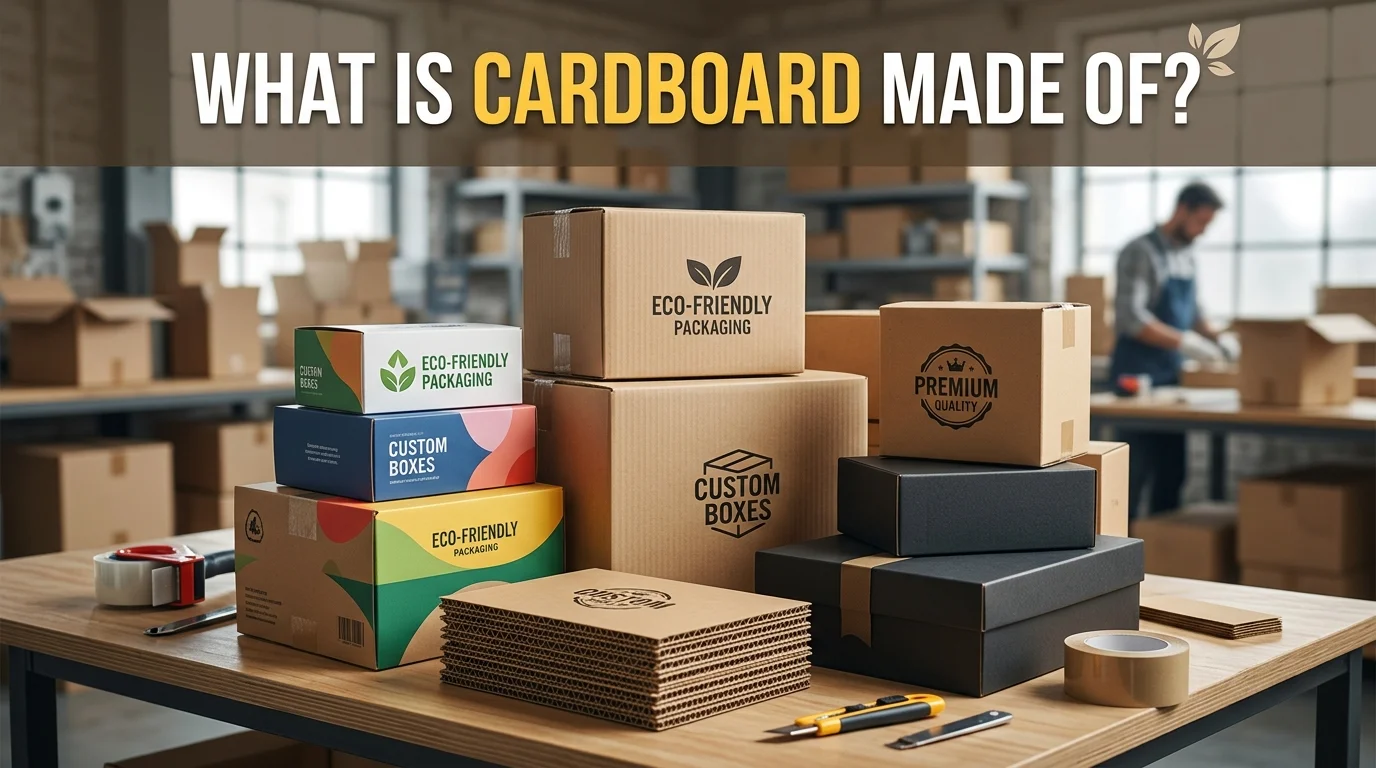
What Is Cardboard Made Of? Composition, Manufacturing, and Recycling Explained
August 19, 2026 Explore Blogs
Quick answer: Cardboard is made from wood cellulose fiber, either virgin wood pulp, recycled paper fiber, or a blend of both, that is processed into paper sheets called linerboard and corrugating medium, then bonded with a starch-based adhesive. The exact composition depends on the type of cardboard: corrugated fiberboard (shipping boxes) uses a fluted paper core glued between two flat liners, while paperboard (cereal boxes, cosmetic cartons) is a single, denser sheet of pressed fiber.
This guide breaks the topic into its component parts: the raw materials, the manufacturing process, the different board types and their technical names, strength testing, and recycling, so you can find a specific, verifiable answer rather than a marketing overview.
What Is Cardboard, Technically?
“Cardboard” is a consumer term, not a technical one. Inside the packaging industry, the material is split into two distinct products:
| Consumer term | Industry term | Structure | Typical use |
| Cardboard box/shipping box | Corrugated fiberboard | Fluted medium glued between one or two flat liners | Shipping, moving, e-commerce |
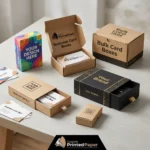
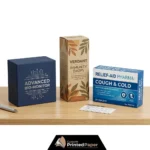
| Cereal box, shoe box, cosmetic box | Paperboard (also SBS, CRB, or chipboard) | Single dense sheet, no fluting | Retail packaging, folding cartons |
| Greeting cards, tags, index cards | Card stock/cover stock | Heavy single-ply paper | Printing, crafts, business cards |
Both corrugated fiberboard and paperboard start from the same base ingredient, cellulose fiber from wood or recycled paper, but differ in how that fiber is layered and pressed.
What Cardboard Is Made Of: The Three Core Materials
Wood fiber from softwood and hardwood provides the strength, stiffness, and smoothness needed for corrugated liners and fluting. Recycled fiber from used boxes and paper waste is also widely reused, often blended with virgin pulp to maintain performance. Starch-based adhesives bond the layers, while additives such as sizing agents, wet-strength resins, and coatings improve moisture resistance, strength, and print quality.
1. Wood Fiber (Virgin Pulp)
Most linerboard and corrugating medium starts as pulped wood.
- Softwood species (pine, spruce, fir) contribute long, strong fibers used in the outer liners for tensile strength.
- Hardwood species (birch, eucalyptus, aspen) contribute shorter fibers that create a smoother, more printable surface.
- Wood is converted to pulp mainly through the kraft process, a chemical pulping method using sodium hydroxide and sodium sulfide to dissolve lignin and free the cellulose fibers. Kraft pulp is what gives brown “kraft paper” boxes their name and natural tan color. A smaller share of corrugating medium uses semi-chemical pulping, which retains more of the wood’s natural stiffness, useful for the fluted layer, which needs to resist crushing rather than tearing.
2. Recycled Fiber (Recovered Paper)
Recycled cardboard fiber, sometimes labeled OCC (old corrugated containers) in the recycling industry, comes from:
- Used shipping boxes collected through curbside and commercial recycling
- Retail and warehouse packaging waste
- Office paper and print scrap (for paperboard grades)
Recycled fiber can typically pass through the pulping and papermaking process five to seven times before the fibers shorten and weaken too much to bond into new sheets, at which point they’re usually used in lower-grade applications like the fluted medium rather than the outer liner. Because containerboard mills draw heavily on recovered fiber, the fiber content of most shipping boxes today is a blend of recycled and virgin pulp, with the exact ratio set by mill specifications, box strength requirements, and regional recycling infrastructure rather than a fixed industry standard.
3. Starch-Based Adhesive and Additives
The fluted medium is bonded to the liners with an adhesive, almost always a starch glue derived from corn, wheat, or potato starch, cooked with water and a small amount of borax or caustic soda to control viscosity and set speed. Starch adhesive is used industry-wide because it:
- Bonds quickly under heat on high-speed corrugating lines
- Is inexpensive at the volumes mills require
- Is biodegradable and doesn’t interfere with the recyclability of the fiber
Depending on the end use, mills also apply minor additives: sizing agents (to control how much the paper absorbs water or ink), wet-strength resins (for produce boxes or wax-alternative coatings), and surface coatings (to improve print clarity on retail-facing paperboard).
How Cardboard Is Manufactured
The manufacturing process begins with pulping, where wood or recovered paper is broken into cellulose fibers and cleaned of contaminants. During papermaking, the fiber slurry is formed into sheets, pressed, dried, and produced as linerboard or corrugating medium. In corrugating, the medium is shaped into flutes, bonded to liners with starch adhesive, and layered into single-, double-, or triple-wall board before being cut and formed into cartons.
Step 1: Pulping
Wood chips and/or recovered paper are broken down mechanically or chemically in water to separate cellulose fibers from lignin and contaminants. Recycled input goes through additional cleaning stages to remove ink, staples, tape, and plastic film; this is why heavily contaminated cardboard is rejected at recycling facilities before it ever reaches this stage.
Step 2: Papermaking (Sheet Formation)
The diluted fiber slurry is sprayed onto a moving wire mesh on a Fourdrinier paper machine. Water drains by gravity and vacuum; the wet mat is pressed between rollers to remove more moisture, then dried over heated cylinders. The output is a continuous reel of paper, either linerboard (for the flat outer layers) or the base sheet used to make corrugating medium.
Step 3: Corrugating
For corrugated fiberboard specifically:
- A fluting machine (corrugator) uses heat and pressure to shape the medium into a repeating wave pattern.
- The peaks of the wave are coated with hot starch adhesive and pressed against a flat liner, forming single-face board.
- A second liner is glued to the opposite side, creating single-wall board, the standard for most shipping cartons.
- For heavier loads, a second fluted layer and liner are added to make double-wall or triple-wall board.
- The continuous sheet is cut, scored, and die-cut into box blanks, then folded and glued into finished cartons.
Flute Types: The Detail Most Guides Skip
The wave-shaped medium inside corrugated board, the flute, comes in standardized profiles that determine cushioning, stacking strength, and print quality. This is a key entity in corrugated packaging that most consumer explanations omit:
| Flute | Approx. thickness | Flutes per foot | Characteristics |
| A-flute | ~4.7 mm | ~33 | High cushioning, strong stacking strength |
| B-flute | ~2.5 mm | ~47 | Good crush resistance, common for retail packaging |
| C-flute | ~3.6 mm | ~39 | The default for most shipping boxes, balance of strength and printability |
| E-flute | ~1.5 mm | ~90 | Thin, excellent print surface, used for small product packaging |
| F-flute | ~0.8 mm | ~128 | Micro-flute for premium retail and point-of-sale boxes |
Combining flutes (e.g., B/C double wall) increases puncture and stacking resistance for heavy or fragile shipments.
What Makes Cardboard Strong? The Metrics That Actually Matter
Rather than describing strength in vague terms, the industry rates boxes with two standardized tests:
- Edge Crush Test (ECT): measures how much force the vertical edge of the fluted medium can withstand before crushing; this determines stacking strength in a warehouse or truck.
- Mullen Burst Test: measures how much pressure the flat face of the board can take before rupturing; this reflects puncture resistance.
Boxes printed with a “32 ECT” or “200# Mullen” rating (common on the bottom flap) are giving you a verifiable strength spec, not a marketing claim. Other factors affecting strength:
- Fiber length and virgin-vs-recycled ratio: longer, virgin fibers generally add tensile strength.
- Basis weight / GSM (grams per square meter): heavier board resists crushing better.
- Moisture content: cellulose fiber loses rigidity when wet, which is why humidity and dampness are the leading cause of box failure during storage or shipping.
- Box design: Properly scored folds and correctly sized boxes distribute load better than an oversized or poorly folded carton.
Is Cardboard Recyclable? What the Data Actually Shows
Direct answer: Yes. Cardboard is among the most recycled packaging materials in the United States, though the exact recycling rate depends on which agency’s methodology you use.
- The American Forest & Paper Association (AF&PA) reported a 2024 cardboard recycling rate of 69%–74%, equal to more than 33 million tons about 90,000 tons of cardboard recycled per day nationwide.
- The U.S. EPA’s more conservative generation-based estimate puts the actual recovery rate closer to 53.5%, reflecting a gap between what’s collected at facilities and what’s generated in the first place.
- Roughly 79% of Americans have access to curbside residential recycling that accepts cardboard.
This discrepancy exists because AF&PA measures recovered material against mill demand, while the EPA measures it against total generation, a distinction worth knowing if you see conflicting recycling-rate claims elsewhere.
How to Recycle Cardboard Correctly
- Flatten boxes to save collection space.
- Remove non-paper elements where practical: plastic tape, foam inserts, packing peanuts.
- Keep it dry. Wet fiber weakens during reprocessing and can contaminate a full recycling batch.
- Greasy pizza boxes: the EPA and AF&PA both now confirm these can be recycled even with some grease, reversing older guidance many haulers used to give.
Environmental Profile: Cardboard vs. Plastic
| Factor | Cardboard | Conventional plastic packaging |
| Source material | Renewable (wood fiber) | Non-renewable (petroleum-based) |
| Recyclability | Widely recyclable, 5–7 reprocessing cycles | Recyclable but with lower real-world recovery rates |
| Biodegradability | Breaks down naturally (weeks to months) | Persists for decades to centuries |
| Certification signal | Look for FSC or SFI labels indicating responsibly sourced fiber | No equivalent forestry-based standard |
Cardboard isn’t automatically the lower-impact choice in every scenario; production energy, transport weight, and reuse cycles all matter, but on end-of-life recovery and biodegradation, fiber packaging outperforms most single-use plastic.
Frequently Asked Questions
What is cardboard made of, in one sentence?
Cardboard is made from wood or recycled cellulose fiber, pulped and pressed into paper sheets, then, for corrugated board, glued into a fluted-and-liner sandwich using starch-based adhesive.
Is cardboard made of wood?
Yes, partially. Cardboard’s fiber originates from wood pulp, but most cardboard today also contains a significant share of recycled paper fiber rather than 100% virgin wood.
Is cardboard made of paper?
Essentially, yes, cardboard is a thicker, layered form of paper. Paperboard is a single dense paper sheet; corrugated cardboard is three or more paper layers (liner, flute, liner) bonded together.
What’s the difference between cardboard and corrugated cardboard?
“Cardboard” is the general term. “Corrugated cardboard” specifically refers to board with a fluted middle layer, the material used in shipping boxes. Paperboard, a single flat sheet, is also colloquially called cardboard but has no flutes.
Is cardboard biodegradable and compostable?
Yes to both, in most cases. Uncoated cardboard breaks down through microbial action within weeks to months and can go in a home compost in moderate amounts. Glossy, plastic-laminated, or heavily printed cardboard may need to be recycled rather than composted.
How many times can cardboard be recycled?
Roughly five to seven times before the cellulose fibers become too short to bond into a new sheet, after which the fiber is typically used in weaker interior layers or ultimately biodegrades.
What percentage of cardboard boxes are made from recycled material?
It varies by mill and end use; there’s no single fixed percentage. Containerboard mills use a blend of recovered and virgin fiber, with AF&PA reporting that nearly half of all recycled paper collected in the U.S. goes into making new containerboard.
Sources
- American Forest & Paper Association (AF&PA), 2024 Cardboard Recycling Data
- U.S. Environmental Protection Agency, recycling rate estimates (via Resource Recycling, 2025)
- Waste Management Bulletin, Paper and cardboard waste in the United States: Geographic, market, and energy assessment (2024)
This guide is maintained for accuracy against current AF&PA and EPA reporting. Figures reflect the most recently published data as of August 2026 and may be revised as new annual reports are released.