


What Is Screen Printing? A Complete Guide for Small Business Owners
July 16, 2026 Explore Blogs
Your packaging is the first physical conversation your brand has with a customer. Before they open the box, before they see the product, they see your print. And for small business owners who want that print to look bold, professional, and unmistakably theirs — screen printing on custom boxes is one of the most powerful options available.
But what exactly is screen printing on custom retail boxes, how does the process work, and is it the right choice for your business? This guide answers every question, from the basics of the process to ink types, minimum order quantities, cost expectations, and when to choose screen printing over other box printing methods.
What Is Screen Printing on Custom Packaging Boxes?
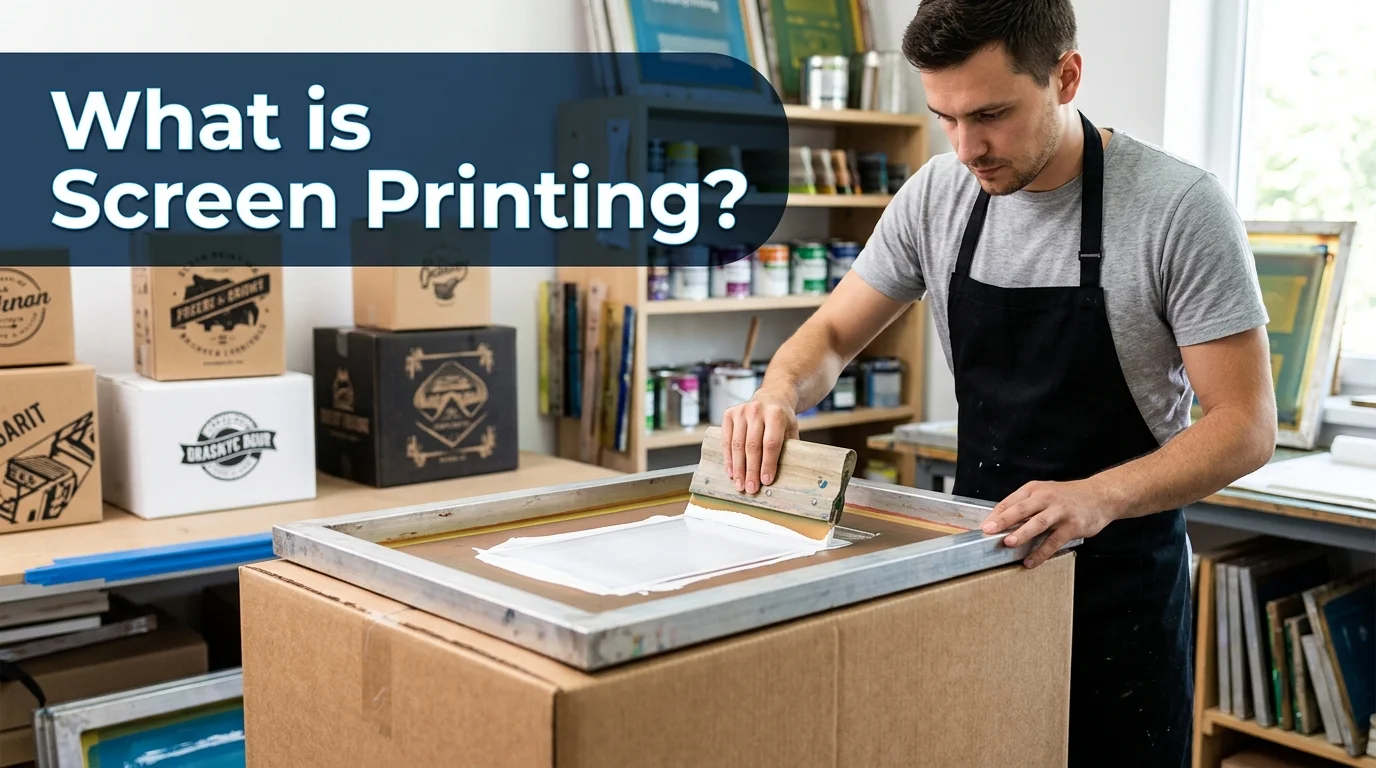
Screen printing — also known as silkscreen printing — is a stencil-based printing technique in which ink is pushed through a tensioned mesh screen onto a surface using a rubber blade called a squeegee. A photosensitive emulsion creates a stencil on the screen, blocking ink in areas that should remain blank and allowing it to pass through only where your design should appear.
When applied to custom packaging boxes, screen printing transfers your logo, brand name, artwork, or pattern directly onto the surface of corrugated cardboard, rigid boxes, kraft paper mailers, folding cartons, or paperboard packaging. The result is a thick, opaque, vivid layer of ink that sits on the surface of the substrate — creating a tactile, high-quality finish that is immediately associated with premium brand presentation.
For small businesses and startups, screen-printed custom boxes signal professionalism. They communicate that you have invested in your brand identity, that the unboxing experience matters to you, and that the product inside is worth the packaging it arrived in.
How Screen Printing on Custom Boxes Works
Screen printing on custom boxes is a popular printing method used to create bold, vibrant, and durable designs on packaging surfaces. This technique involves transferring ink through a mesh screen onto the box material. Businesses use screen printing for logos, graphics, and branding because it offers excellent color quality and long-lasting visual appeal.
Step 1 — Artwork Preparation and Color Separation
Screen printing is a spot-color process. Every color in your design requires its own dedicated screen. A logo with two colors — say, black and gold — requires two screens. A three-color design requires three. This is why screen printing works best for logos, wordmarks, simple graphics, and bold patterns rather than full-color photographic imagery.
Your artwork should be supplied as a vector file (Adobe Illustrator AI, EPS, or SVG) with clean, sharp edges. Vector artwork scales without quality loss and makes color separation straightforward. Each color is isolated onto a separate film positive — a transparent acetate sheet that carries only that layer of the design — which is then used to create the screen stencil.
If your brand uses standardized Pantone (PMS) colors, screen printing can match them precisely, because inks are hand-mixed to formula. This level of color accuracy is critical for brand consistency across product lines, product launches, and seasonal packaging campaigns.
Step 2 — Screen Coating with Photoemulsion
Each mesh screen is coated with photosensitive emulsion — a light-reactive chemical layer that hardens when exposed to ultraviolet light. The film positive for each color is placed onto the emulsion-coated screen and exposed to a UV light source.
The clear areas of the film (your design) allow UV light through, hardening the emulsion beneath. The opaque areas (where ink should not print) block the light, keeping the emulsion soft. When the screen is washed with water, the unhardened emulsion washes away — leaving a precise, open stencil in the exact shape of your design.
This photoemulsion stenciling process creates crisp, reproducible edges that hold up across thousands of print cycles — which is why screen printing is the preferred method for high-volume custom packaging runs.
Step 3 — Ink Application and Printing
The custom box blank is positioned precisely beneath the screen on a printing platen. Ink is poured onto the screen and the printer drives the squeegee across in a single controlled stroke, forcing ink through the open mesh areas directly onto the box surface.
Each color is applied separately. Between color passes, flash curing — brief, intense heat — partially sets the ink to prevent wet-on-wet smearing. Once all color layers are applied, the box passes through a conveyor dryer or is heat-cured to bring the ink to its full cure temperature, bonding it permanently to the substrate.
For packaging with multiple print faces (all four sides, top and bottom), each face is printed separately, making registration — the precise alignment of each color layer — a critical quality checkpoint throughout production.
Ink Types Used in Custom Box Screen Printing
The type of ink used in screen printing on boxes directly affects durability, appearance, environmental impact, and the range of special effects available.
Plastisol Ink is the most widely used ink in commercial screen printing. It produces bold, opaque, highly saturated colors and does not dry in open air — it only cures under heat — making it practical for production runs. On packaging, plastisol delivers a slightly raised, tactile surface feel that many premium brands specifically request.
Water-Based Ink is increasingly popular for its environmental credentials and softer finish. Rather than sitting on top of the substrate, water-based ink partially penetrates the paper fiber, creating a matte, natural appearance with lower visual texture. For kraft packaging, uncoated cardboard, and eco-branded businesses, water-based inks produce results that look organic and intentional.
UV-Curable Ink is cured instantly by exposure to ultraviolet light rather than heat. UV inks are highly resistant to scratching, moisture, and fading — making them ideal for boxes that need to withstand shipping, retail shelf exposure, or outdoor conditions. The finish is typically high-gloss and extremely vibrant.
Specialty Inks are where screen printing truly separates itself from every other printing method. Metallic inks (containing aluminum or bronze flakes) create genuine reflective, shimmering effects. Glitter inks embed reflective particles for a festive, tactile quality. Fluorescent inks pop under standard and UV lighting. Spot varnish can be applied through screen to create a high-gloss pattern over a matte background — a luxury packaging technique widely used in cosmetics, spirits, and premium retail. None of these effects are achievable through digital printing, offset, or flexography at the same cost point for small runs.
What Types of Custom Boxes Work With Screen Printing?
Screen printing is compatible with a wide range of custom packaging substrates. Understanding which box types work best helps small businesses make informed decisions when briefing a print supplier.
Corrugated Cardboard Boxes — the standard for e-commerce shipping — can be screen printed, though the fluted texture of the corrugation affects how finely detailed the print can be. Bold logos and simple graphics work best. For finer detail on corrugated, a liner sheet printed separately and applied to the box surface is an alternative approach.
Rigid Boxes (also called set-up boxes) are used for premium product packaging: cosmetics, jewelry, electronics, luxury goods. The dense, smooth surface of a rigid box is ideal for screen printing and produces exceptionally crisp results. Screen-printed rigid boxes with spot metallic or varnish effects are a hallmark of high-end unboxing experiences.
Folding Cartons and Paperboard Boxes — used for retail, food, cosmetics, and subscription boxes — are among the most common substrates for screen printing. The smooth coated surface accepts ink cleanly, making it suitable for 1–4 color simple designs with high precision.
Kraft Mailers and Paper Bags offer a natural, uncoated surface that pairs particularly well with water-based inks. For brands with an organic, artisanal, or sustainable positioning, screen-printed kraft packaging with water-based ink is an aesthetically cohesive choice.
Screen Printing vs. Other Custom Box Printing Methods
Small business owners frequently encounter multiple printing options when sourcing custom packaging. Here is how screen printing compares with the most common alternatives:
Screen Printing vs. Flexographic Printing
Flexography (flexo) is the dominant method for very high-volume corrugated and folding carton printing. It uses flexible rubber or photopolymer plates to transfer ink at high speed, making it extremely cost-efficient at 10,000+ units. Screen printing is more practical for smaller runs (50–5,000 units), offers superior color opacity, and allows specialty ink effects that flexo cannot replicate. For most small businesses, screen printing is the more accessible entry point.
Screen Printing vs. Digital Box Printing
Digital inkjet printing on packaging allows full-color photographic designs with no setup costs and no minimum quantities — ideal for one-off prototypes, personalized packaging, or designs with complex gradients and photography. However, digital inks sit closer to the surface and are generally less opaque and less durable than screen printing. For bold, single-brand logos in 1–4 colors on runs of 50+ units, screen printing produces a more vibrant and professional result at a lower per-unit cost.
Screen Printing vs. Foil Stamping
Hot foil stamping uses a heated metal die to press metallic foil directly onto the surface, creating a mirror-bright finish. The result is luxurious and distinctive — but the tooling costs are high and the process works only on flat surfaces without texture variation. Screen printing with metallic ink is a more accessible alternative that achieves a similar premium appearance at lower setup costs, with the added flexibility to print any shape without custom die production.
Cost and Minimum Order Quantities for Screen-Printed Custom Boxes
Understanding the economics of screen printing helps small businesses plan their packaging budgets accurately.
Setup costs — the cost of creating the physical screens — typically range from $30 to $80 per screen, per color. A two-color logo on a custom box requires two screens, meaning a setup cost of approximately $60–$160 before any boxes are printed. This is a one-time cost: screens can be stored and reused for repeat orders, eliminating setup charges on future runs of the same design.
Minimum order quantities (MOQs) for screen-printed custom boxes generally start at 50–100 units for simple one-color designs, with the most competitive per-unit pricing beginning at 250–500 units. Because the setup cost is fixed regardless of run size, the per-unit cost decreases significantly as quantity increases — making screen printing progressively more cost-efficient the more units you order.
Per-unit cost is influenced by box size, number of colors, number of printed faces, substrate type, and ink type. Water-based and specialty inks typically carry a small premium over standard plastisol. As a general guideline, a simple one-color screen-printed folding carton in a run of 500 units can be produced for between $0.80 and $2.50 per unit, depending on box dimensions and complexity.
For early-stage startups ordering fewer than 50 units, digital box printing or stock boxes with custom labels may be more economical until volume justifies the screen printing setup investment.
Why Screen Printing on Custom Boxes Is a Smart Choice for Small Businesses
Screen printing offers a specific combination of qualities that makes it particularly well-suited for small businesses building a brand from the ground up.
Brand Consistency At Scale
With Pantone-matched inks, your brand color on the box will match your brand color on your website, your business cards, and your labels — consistently, across every production run. This level of color precision is not reliably achievable through digital printing.
Durability Through The Supply Chain
Screen-printed inks — particularly UV-curable and plastisol formulations — resist scuffing, moisture, and abrasion during shipping and retail handling. Your boxes arrive at the customer looking exactly as they left the printer.
Premium Perception At Accessible Cost
Customers associate screen-printed packaging with quality. The thickness of the ink, the sharpness of the edge, the tactile quality of the surface — these are physical signals of brand investment that digital printing cannot fully replicate. For small businesses competing against larger, better-funded brands, premium packaging is a meaningful differentiator.
Special Effects That Create Memorability
A metallic ink logo. A glitter accent on a seasonal box. A spot varnish pattern that catches the light. These are the finishing details that turn a functional shipping container into a shareable unboxing experience — the kind that ends up in customer social media posts, product review videos, and word-of-mouth recommendations.
Sustainability Considerations
Environmental responsibility is an increasingly important factor in packaging decisions, particularly for startups building brands with sustainability as a core value.
Water-based inks are significantly lower-impact than plastisol: they contain no PVC or phthalates, cure with lower energy requirements, and require only water for screen cleanup — eliminating the chemical solvents associated with traditional ink reclaiming. Specifying water-based inks when ordering screen-printed packaging is a meaningful, verifiable sustainability commitment.
Recyclable substrate selection matters too. Screen-printed corrugated and paperboard boxes are generally compatible with standard paper recycling streams, particularly when printed with water-based inks. UV-curable coatings and plastisol-heavy prints may require verification with your local recycling authority.
For brands pursuing sustainability certifications or communicating eco-credentials to customers, pairing water-based screen printing with FSC-certified paperboard substrates is the packaging approach most aligned with environmental standards.
Ready to Put Your Brand on Every Box?
At CustomPrintedPaper, we specialize in helping small businesses and startups create custom packaging that tells their brand story from the outside in. Whether you need a bold single-color logo on a kraft mailer, a Pantone-matched luxury rigid box, or a full specialty-ink custom folding carton — our team guides you through every step, from artwork preparation to final production.
Here’s what working with CustomPrintedPaper looks like:
- Free artwork consultation and color separation guidance
- Pantone color matching on all screen-printed orders
- Water-based and specialty ink options available on all box types
- Transparent pricing with no hidden setup fees
- Low minimums designed for growing businesses
Your packaging deserves the same care as your product. Let’s build something your customers will remember.
Get a free custom box quote from Custom Printed Paper today and discover what screen printing can do for your brand.