





What Is a Standard Envelope Size? Complete Guide
July 10, 2026 Explore Blogs
When you’re preparing a mailing, printing invitations, or setting up a business correspondence system, one question comes up almost immediately: what is a standard envelope size, and how do you know which one fits your project? Envelope sizing isn’t arbitrary. It’s built around decades of postal regulations, paper industry conventions, and practical needs like fitting a folded letter, a greeting card, or an unfolded report. Understanding envelope format, reading an envelope size chart correctly, and knowing the standard envelope size in inches for common categories will save you time, money, and the embarrassment of a mail piece that gets bounced back for non-machinable postage.
This guide breaks down what “standard” really means in the envelope world, walks through the most widely used envelope sizes by category, and explains how to match the right envelope format to your document, card, or mailing piece.
Defining “Standard” in Envelope Sizes
A standard envelope size is a dimension that has become an industry norm because it matches common paper sizes, postal classification rules, or long-established printing conventions. In the United States, these dimensions are expressed in inches, while much of the rest of the world (and some U.S. specialty printing) uses millimeters based on ISO paper standards like the A-series and C-series.
Standard sizing exists for a practical reason: predictability. When an envelope size chart lists a #10 or a 6×9, printers, mailing houses, and postal carriers all know exactly what dimensions, weight limits, and folding requirements apply. This predictability is what keeps postage costs consistent and prevents your mail from being rejected or surcharged by the postal service.
The United States Postal Service (USPS) actually plays a direct role in shaping what counts as “standard.” USPS classifies mail pieces as either letters or flats based on strict dimensional and weight thresholds. A letter-class envelope must generally stay within roughly 6.125 inches by 11.5 inches and no more than about a quarter-inch thick, while anything larger is classified as a flat and billed at a higher postage rate. This classification system is one of the biggest reasons envelope formats settled into the specific sizes we use today.
Common Envelope Format Categories
Envelopes aren’t one-size-fits-all, and the industry groups them into recognizable categories based on use case. Here’s how the major envelope formats break down.
Business and Commercial Envelopes
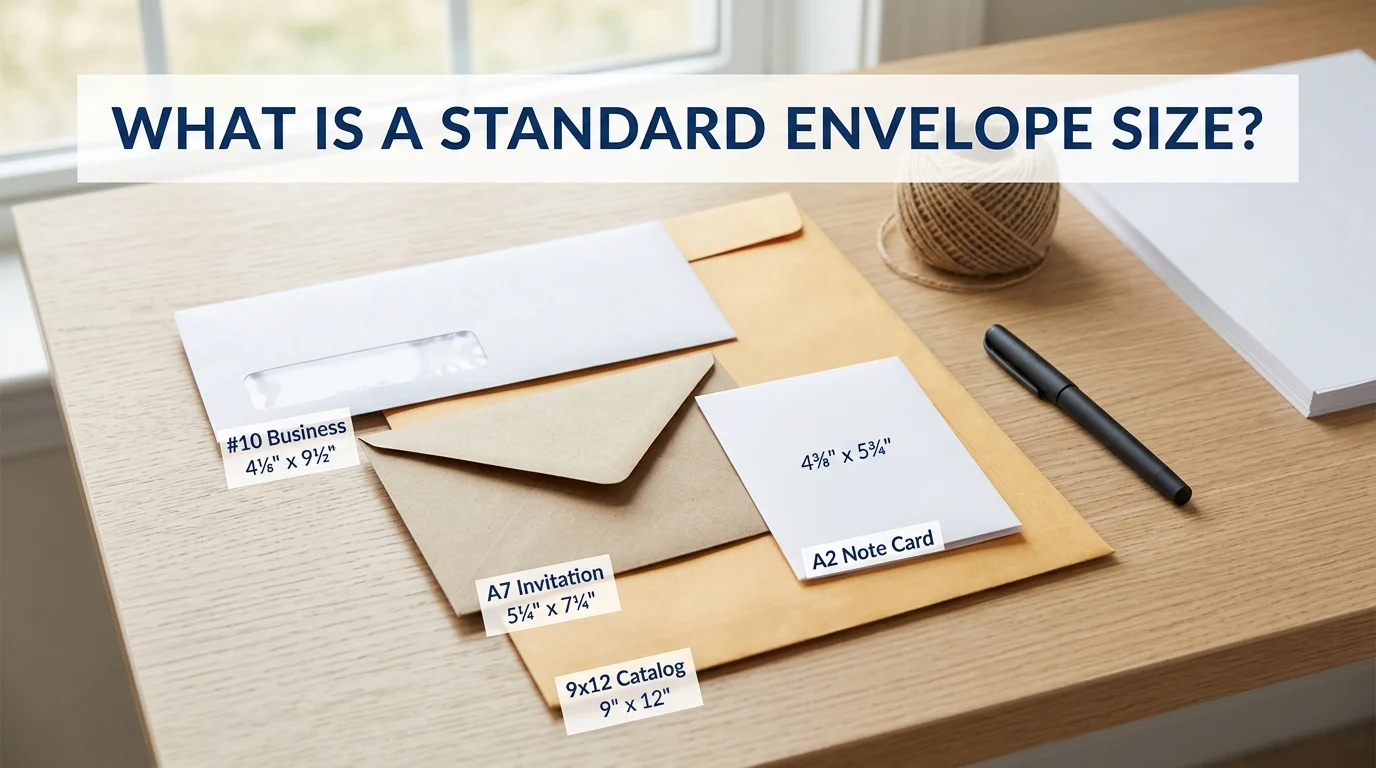
Business envelopes are the everyday workhorses of corporate mail — used for invoices, statements, letters, and notices. The most recognized standard envelope size in inches for this category is the #10 envelopes, measuring 4.125 x 9.5 inches. It’s the default choice for outbound mail because it comfortably holds a standard 8.5 x 11-inch sheet of paper folded into thirds, and it runs smoothly through automated inserting equipment used by high-volume mailers.
Close behind the #10 is the #9 envelope, at 3.875 x 8.875 inches, which is slightly smaller and commonly used as a reply envelope that nests neatly inside a #10. This pairing — a #10 outer envelope with a #9 or #6 3⁄4 return envelope enclosed — is extremely common for billing, subscriptions, and nonprofit mailings.
The #6¾ envelope measures 3.625 x 6.5 inches and is popular for personal checks, small forms, and business reply mail. Meanwhile, the Monarch envelope (also called #7¾) measures 3.875 x 7.5 inches and has a distinctive look often used for executive letterhead correspondence, giving it a more formal, personal-branding feel than a standard business envelope.
Booklet and Catalog Envelopes
When a mailing needs to carry more than a folded letter — think brochures, reports, or booklets — booklet and catalog envelope formats take over. These envelopes open on the long edge (booklet style) or the short edge (catalog style) and are built to accommodate flat, unfolded contents.
A 6 x 9 envelope is a common choice for promotional materials, small catalogs, and programs, and it can hold an unfolded piece up to about 5.75 x 8.75 inches. For larger flat mailings, a 9 x 12 envelope is one of the most widely used oversized formats. It fits a standard 8.5 x 11-inch document without any folding at all, making it a go-to for reports, contracts, and marketing sheets that need to stay crisp and presentable.
Announcement and Invitation Envelopes
Invitation and announcement envelopes follow a different naming convention entirely: the A-series. These sizes are designed to match standard card stock dimensions, which makes them a natural fit for wedding invitations, greeting cards, and formal event announcements. An A2 envelope, for example, is one of the smallest in this series and is often described as a note card size, while larger options like A7 and A9 accommodate bigger invitation suites with multiple inserts.
Baronial envelopes are a related but distinct format, recognizable by their deep, pointed flap and diagonal seams. They’re frequently chosen for upscale business announcements, VIP event invites, and premium direct mail where presentation matters as much as function.
Specialty and Legal Envelopes
Beyond everyday business and social mail, there’s a category of specialty envelopes designed for thicker or more sensitive contents. Legal-size envelopes, often around 9 x 14 inches, are built to hold legal documents without requiring them to be folded, which matters when a signature page or seal needs to stay intact and readable. Expansion envelopes, clasp envelopes, and policy envelopes fall into this same specialty bucket, offering reinforced construction for contracts, HR packets, and multi-page documents that would look unprofessional if creased.
Standard Envelope Size Chart (Inches and Millimeters)
Here’s a quick-reference envelope size chart covering the formats discussed above:
| Envelope Type | Size in Inches | Approximate Size in mm | Common Use |
| #6¾ | 3.625 x 6.5 | 92 x 165 | Checks, small reply mail |
| #7¾ (Monarch) | 3.875 x 7.5 | 98 x 190 | Executive letterhead |
| #9 | 3.875 x 8.875 | 98 x 225 | Reply envelope inside a #10 |
| #10 | 4.125 x 9.5 | 105 x 241 | Standard business letters, invoices |
| A2 | 4.375 x 5.75 | 111 x 146 | Note cards, small invitations |
| 6 x 9 | 6 x 9 | 152 x 229 | Booklets, brochures, catalogs |
| 9 x 12 | 9 x 12 | 229 x 305 | Unfolded documents, reports |
| Legal | 9 x 14 | 229 x 356 | Legal documents |
| C4 | 9 x 12.75 | 229 x 324 | International A4 documents |
Keep in mind that exact fractional measurements can vary slightly by manufacturer, so always confirm dimensions against the specific supplier’s envelope size chart before placing a large print order.
How to Choose the Right Envelope Size
Selecting the correct envelope format comes down to matching the envelope to what’s going inside it, then checking that combination against postal rules.
Start with the insert, not the envelope. Figure out the exact dimensions of what you’re mailing a folded letter, a flat sheet, a card, or a multi-page packet before picking an envelope size. A good general rule is to allow about a quarter-inch of clearance on both height and width once the contents are folded, so the paper slides in without curling, catching on seams, or wrinkling.
Consider postal classification. In the U.S., staying within USPS letter-size dimensions (roughly up to 6.125 x 11.5 inches and a quarter-inch thick) keeps you eligible for the lower letter-class postage rate. Anything larger shifts into flat-rate postage, which costs more. If your mailing volume is high, this distinction has a real impact on your budget.
Watch your aspect ratio. Machinable mail must generally have a length-to-height ratio between 1.3 and 2.5. Square envelopes fall outside this range, which means they’re automatically treated as non-machinable and may carry a surcharge something to factor in if you’re drawn to square formats for aesthetic reasons.
Match the envelope style to the purpose. Window envelopes work well for invoices and statements because they eliminate the need to print or write an address separately. Booklet and catalog styles suit brochures and unfolded materials. Baronial and A-series formats are the right call when presentation and brand image matter, such as invitations or premium direct mail.
Why Standard Sizes Matter for Business Mail
Choosing a recognized, standard envelope size in inches isn’t just about tradition — it directly affects how your mail performs. The correct format keeps documents protected, avoids costly postal surcharges, ensures compatibility with automated inserting equipment, and gives your correspondence a clean, professional appearance. Whether you’re sending a routine invoice in a #10, a report in a 9 x 12, or a formal invitation in an A7, understanding envelope sizing helps you avoid returns, delays, and mismatched inserts.
Final Thoughts
Envelope sizing might seem like a small detail, but it touches nearly every part of a mailing project: cost, appearance, postal compliance, and the recipient’s first impression. By using a reliable envelope size chart and matching your insert to the appropriate standard envelope format whether that’s a #10 for everyday business letters, a 6 x 9 for booklets, or an A2 for invitations you set your mail up to arrive intact, look professional, and move through postal systems without unnecessary delays or fees.
Also read: Playing Card Dimensions: The Complete Size Guide for Every Format