







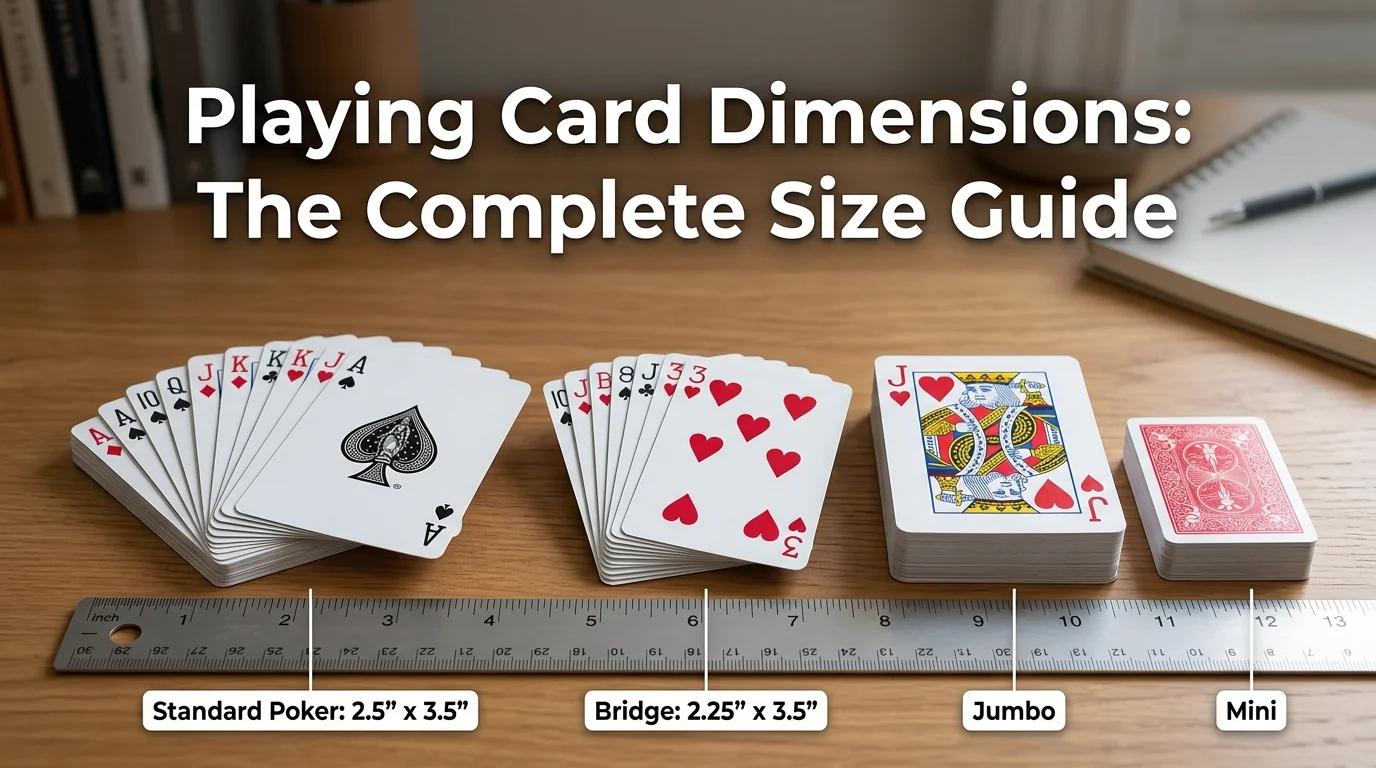
Playing Card Dimensions: The Complete Size Guide for Every Format
June 8, 2026 Explore Blogs
Pick up any standard deck of cards from any country in the world, and the cards will almost certainly measure exactly 2.5 inches wide and 3.5 inches tall. That consistency is not accidental. It is the result of over 150 years of manufacturing standardization, competitive market alignment, and design optimization built around the ergonomics of the human hand.
For casual players, dimensions are invisible. For manufacturers, game designers, magicians, retailers, and custom packaging producers, every millimeter is a deliberate decision. The width of a card determines whether it can be riffle shuffled efficiently. The height governs how it sits in a tuck box. The thickness affects how a deck fans, springs, and handles during professional play and performance.
This guide covers every standard playing card dimension in use today, across every format, from miniature novelty decks to jumbo accessibility cards, along with the box dimensions that house them. Whether you are sourcing cards for retail, designing a custom game, ordering printed packaging, or simply curious about the engineering behind your favorite deck, this is the definitive reference for 2026.
Standard Playing Card Dimensions Explained
The global standard for a single playing card is:
Width: 2.5 inches (6.35 cm / 63.5 mm) Height: 3.5 inches (8.89 cm / 88.9 mm)
These dimensions apply to what the industry calls “poker size” cards, which have become the default format for the vast majority of decks produced worldwide. A standard deck contains 52 cards divided into four suits hearts, diamonds, clubs, and spades — each suit running thirteen ranks from ace through king.
The thickness of an individual card typically falls between 0.17mm and 0.30mm depending on the cardstock used. A full 52-card deck without a box measures approximately 19mm (0.75 inches) in depth. Professional-grade cards, including those used in casinos, tend toward the lower end of that thickness range because thinner cards shuffle more cleanly and fan more precisely.
Cardstock weight is measured in points or grams per square meter (GSM). Standard playing cards typically use 300 GSM cardstock. Casino-grade cards often use custom linen or plastic-coated stock that falls between 280 and 320 GSM.
Complete Playing Card Size Chart by Type
| Card Format | Width | Height | Common Use |
| Poker Size (Standard) | 2.5 in / 63.5 mm | 3.5 in / 88.9 mm | Poker, most card games, magic |
| Bridge Size | 2.25 in / 57.2 mm | 3.5 in / 88.9 mm | Bridge, canasta, hand-held games |
| Miniature | 1.75 in / 44.5 mm | 2.5 in / 63.5 mm | Travel, novelty, collector decks |
| Jumbo | 3.5 in / 88.9 mm | 5.0 in / 127 mm | Accessibility, display, large-group games |
| Tarot Size | 2.75 in / 70 mm | 4.75 in / 120.7 mm | Tarot reading, specialty games |
Each format serves a distinct function. Poker size dominates general use because it optimizes the balance between comfortable grip, efficient shuffling, and legible pip and face card design. Bridge size is narrower by 0.25 inches, which allows players holding large hands of cards to fan them more easily an important ergonomic consideration in games like bridge and canasta where players may hold 13 or more cards simultaneously.
Poker Playing Card Dimensions in Detail
Poker size is the closest thing to a universal playing card standard. The 2.5 x 3.5 inch dimension was formalized during the late 19th century as card manufacturing industrialized, and it has remained unchanged because it works exceptionally well.
The 2.5 inch width fits comfortably in most adult hands. The 3.5 inch height allows enough vertical space to display rank and suit indices in both the top-left and bottom-right corners without crowding the central artwork. The proportions also allow for clean riffle shuffles, overhead shuffles, and one-handed cuts that form the core techniques of both recreational play and card magic.
In casino environments, poker-size cards are used universally at blackjack, baccarat, and poker tables worldwide. This global standardization means that a professional card handler trained in Las Vegas can work with a deck manufactured in Belgium without any adjustment period.
Bridge Size Playing Card Dimensions
Bridge size cards measure 2.25 inches wide by 3.5 inches tall, making them 0.25 inches narrower than poker size while maintaining identical height. That difference is meaningful in practice.
In bridge and similar trick-taking games, players routinely hold 13 cards in a single hand. The narrower bridge-size format allows the hand to fan across a shorter arc, reducing hand strain and making it easier to read card indices without spreading the hand excessively wide.
Bridge size is also used in some canasta sets, certain rummy variants, and collectible card games where hand size is a significant gameplay factor. Outside of those specific applications, poker size has largely supplanted bridge size in the broader market.
Bicycle Playing Card Dimensions
Bicycle playing cards, produced by the United States Playing Card Company, are among the most widely used and recognized decks in the world. Every standard Bicycle deck adheres to poker-size dimensions: 2.5 inches wide by 3.5 inches tall.
This consistency holds across the entire Bicycle product line. The classic Rider Back, the 808 series, specialty and themed editions, and limited collector releases all maintain the same 2.5 x 3.5 inch format. The United States Playing Card Company has maintained this standard deliberately because it ensures that Bicycle cards are compatible with every poker table, card holder, shuffler, and protective sleeve designed for standard poker-size cards.
Bicycle cards are also the preferred choice of most professional magicians. The standard dimensions, combined with the brand’s consistent air-cushion finish and cardstock weight, make them reliable for sleight of hand, flourishes, and card magic performance.
Playing Card Box and Tuck Box Dimensions
The box or tuck box that houses a deck of playing cards must be dimensioned precisely. A box that is too tight damages card edges during insertion and removal. A box with too much interior space allows the deck to shift and corner-warp during storage and transport.
Standard Poker-Size Tuck Box Dimensions
Length (Height): 3.5 inches (88.9 mm) Width: 2.6 inches (6.6 cm) Depth: 0.75 inches (19.05 mm)
The 0.1 inch tolerance on the width (2.6 inches versus the card’s 2.5 inch width) is intentional. It provides just enough clearance for the deck to slide in and out cleanly without the tuck flap creating friction against the card faces.
Bridge-Size Tuck Box Dimensions
Length (Height): 3.5 inches (88.9 mm) Width: 2.25 inches (5.72 cm) Depth: 0.75 inches (19.05 mm)
Standard Poker-Size Box Dimensions (Imperial and Metric)
| Measurement | Inches | Centimeters | Millimeters |
| Length | 3.5 in | 8.89 cm | 88.9 mm |
| Width | 2.6 in | 6.6 cm | 66 mm |
| Depth | 0.75 in | 1.91 cm | 19.05 mm |
Custom Playing Card Box Dimensions
Custom game decks, promotional cards, and specialty editions often use non-standard box dimensions. Common ranges are:
Length: 3.5 to 4.0 inches Width: 2.5 to 3.0 inches Depth: 0.75 to 1.0 inch
The depth dimension is the most variable. Decks with more than 52 cards, oversized tokens, or included rulebooks require deeper boxes. Double decks commonly use boxes with a depth of 1.25 to 1.5 inches.
Miniature Playing Card Box Dimensions
Length: 2.5 to 3.0 inches (commonly) Width: 1.5 to 2.0 inches (commonly) Depth: 0.5 to 0.75 inches (commonly)
Jumbo Playing Card Box Dimensions
Length: 4.0 to 5.0 inches (commonly) Width: 3.0 to 3.5 inches (commonly) Depth: 1.0 to 1.25 inches (commonly)
Miniature and Jumbo Playing Card Dimensions
Miniature Playing Cards
Miniature playing cards typically measure 1.75 inches wide by 2.5 inches tall (4.45 cm x 6.35 cm). This format is approximately 70% the size of a standard poker deck and is produced primarily for travel use, novelty gifting, and collector purposes.
The reduced dimensions make miniature decks impractical for serious gameplay. Shuffling is more difficult, indices are harder to read at a distance, and the cards do not sit cleanly in standard card holders or table rail systems. Their value is portability: a miniature deck fits in a jacket pocket, a carry-on bag pocket, or a travel kit with room to spare.
Jumbo Playing Cards
Jumbo playing cards measure 3.5 inches wide by 5.0 inches tall (8.89 cm x 12.7 cm). This format is primarily designed for accessibility and visibility purposes, making cards readable for players with low vision or visual impairments.
Jumbo cards also see use in large-group settings, classrooms, stage magic performances where visibility from a distance matters, and promotional events where oversized card props serve a display function. The larger surface area makes jumbo cards awkward to shuffle using standard techniques, so most users simply cut and deal rather than performing conventional shuffles.
Historical Evolution of Playing Card Sizes
Playing cards originated in China during the Tang Dynasty (618 to 907 AD) and spread westward through the Islamic world into Europe during the 14th century. Early European playing cards were not standardized in size or format. They were hand-painted, irregular in dimension, and produced by individual craftsmen rather than industrial manufacturers.
The introduction of woodblock printing in the 15th century began moving card production toward greater consistency, but true dimensional standardization did not arrive until the 19th century when the industrial printing press made mass production viable. Card manufacturers recognized that a universal size was essential for the commercial card market: players needed to be confident that a replacement deck would feel identical to the one they were replacing.
By the late 1800s, the 2.5 x 3.5 inch poker-size format had become the dominant North American standard. The United States Playing Card Company, founded in 1867, was instrumental in cementing this standard through the wide distribution of Bicycle brand cards. European manufacturers converged on similar dimensions during the same period, producing the global consistency that still defines the market today.
Custom Playing Card Dimensions and Design Considerations
Custom playing card production for board games, trading card games, branded promotional decks, and collector editions introduces flexibility into the otherwise rigid dimension standards.
The most important design constraint remains the relationship between card dimensions and tuck box dimensions. A custom card that deviates significantly from standard poker or bridge sizing requires a custom box, which increases both tooling costs and per-unit packaging costs.
Most game designers who commission custom decks choose to maintain the 2.5 x 3.5 inch poker format even when designing entirely original games, precisely because it allows them to use standard tuck box templates and take advantage of competitive pricing from large-format card printers.
Card thickness is often the more meaningful customization variable. Premium custom decks frequently use heavier cardstock (310 to 330 GSM) or add linen texture embossing to differentiate the tactile experience without changing the exterior dimensions.
Corner radius is another subtle but meaningful dimension in custom card design. Standard playing cards use a corner radius of approximately 3.5mm (0.138 inches). Rounder corners (up to 5mm) give a card a more premium feel and reduce corner wear during heavy use, while sharper corners (2mm to 3mm) are sometimes used in trading card games to allow precise stacking and alignment.
The Expertise Behind Every Deck
Playing card dimensions are not arbitrary. Every measurement, from the 2.5 inch width of a standard poker card to the 0.75 inch depth of a tuck box, reflects decisions made over 150 years of manufacturing refinement, ergonomic research, and global market standardization.
The 2.5 x 3.5 inch poker size format remains the undisputed global standard in 2026 because it works. It fits the human hand, shuffles cleanly, reads clearly across gaming tables, and fits universally into the accessories, cases, and packaging systems built around it. Variations like bridge size, miniature, and jumbo formats serve genuine purposes for specific audiences, but they represent exceptions to a remarkably consistent rule.
For consumers, understanding card dimensions helps in selecting the right deck for a game. For designers and game developers, it establishes the dimensional framework within which almost all successful card products are built. For retailers and distributors, standard dimensions mean predictable storage, display, and logistics requirements.
And for anyone sourcing custom-printed playing cards or card packaging, precise dimensional knowledge is the starting point for every production decision that follows.
Need Custom Playing Card Packaging Printed to Exact Specifications?
If you are producing a custom card game, a branded promotional deck, a retail playing card product, or specialty tuck boxes, CustomPrintedPaper delivers precision-printed card packaging built to your exact dimensional requirements.
We produce standard poker-size tuck boxes, bridge-size tuck boxes, custom dimension boxes for specialty decks, double-deck and multi-component game packaging, and short-run custom packaging for independent game designers. Every order is produced to tight dimensional tolerances, with full Pantone color matching, lamination options, and structural engineering appropriate to your card format and quantity.
Get a custom quote from CustomPrintedPaper today and bring your card game packaging to life exactly as you designed it.
Contact CustomPrintedPaper to speak with a packaging specialist about your project.
Frequently Asked Questions
What are the standard dimensions of a playing card?
A standard poker-size playing card measures 2.5 inches wide by 3.5 inches tall (63.5 mm x 88.9 mm). This is the global default for most card games, including poker, blackjack, and the majority of collectible and custom card games.
What is the difference between poker size and bridge size cards?
Poker-size cards are 2.5 inches wide. Bridge size cards are 2.25 inches wide. Both formats share the same 3.5-inch height. Bridge size is narrower to accommodate the larger hands players hold in bridge and similar games.
What are the Bicycle playing card dimensions?
All standard Bicycle playing cards measure 2.5 inches by 3.5 inches, consistent with the poker size standard. This applies across every Bicycle product line, from the classic Rider Back to specialty and limited edition decks.
What are the tuck box dimensions for poker-size cards?
A standard poker-size tuck box measures 3.5 inches in length, 2.6 inches in width, and 0.75 inches in depth (88.9 mm x 66 mm x 19.05 mm).
How big are miniature playing cards?
Miniature playing cards typically measure 1.75 inches wide by 2.5 inches tall, making them suitable for travel but impractical for serious gameplay.
How big are jumbo playing cards?
Jumbo playing cards measure approximately 3.5 inches wide by 5.0 inches tall, designed primarily for accessibility and large-group visibility.
Can Bicycle cards be used for magic tricks?
Yes. Bicycle poker-size cards are the most commonly used cards in card magic. Their consistent dimensions, air-cushion finish, and predictable cardstock weight make them the preferred tool of professional magicians worldwide.
Why is poker size considered the universal standard?
Poker size became the universal standard through 19th century industrial standardization, anchored by major manufacturers including the United States Playing Card Company. The 2.5 x 3.5 inch format optimizes the balance between grip comfort, shuffling efficiency, and design legibility, making it the practical default for the global card market.