







World of Cereal Mascots: From Iconic Characters to Cherished Childhood Memories
May 19, 2026 Explore Blogs
Every morning, millions of children sit down to breakfast and are greeted not just by a bowl of cereal but by a familiar face staring back at them from the box. A striped tiger flashing a confident grin. A rabbit perpetually outsmarted yet never defeated. A trio of tiny elves that snap, crackle, and pop.
Cereal mascots are far more than printed artwork on cardboard. They are cultural touchstones, characters that have shaped how entire generations experience breakfast, advertising, and childhood itself. In this deep dive, we explore the rich history, psychology, and lasting legacy of cereal mascots and explain why they remain one of the most powerful branding tools in the food industry.
What Are Cereal Mascots and Why Do They Matter?
A cereal mascot is a branded character, fictional, anthropomorphic, or loosely based on a real-world creature, used by breakfast cereal manufacturers to represent a product and connect emotionally with consumers, particularly children and families.
The significance of these characters extends well beyond package design. According to consumer psychology research, mascots create parasocial relationships, one-sided emotional bonds that consumers form with fictional characters. When a child roots for the Trix Rabbit to finally get his cereal, they are emotionally invested in the brand. That investment translates into purchase behavior, brand loyalty, and lifelong memory.
In the field of food marketing, cereal mascots sit at the intersection of character branding, package design, television advertising, and childhood nostalgia, all of which are semantic entities that define this category and its cultural weight.
The Origins and Evolution of Cereal Mascots
The story of cereal mascots begins in the early 20th century, when breakfast cereal was a relatively new product category, and companies needed compelling ways to differentiate their offerings on the grocery shelf.
The Early Era (1900s–1940s)
The Quaker Man, the robed Quaker figure on Quaker Oats packaging, is widely regarded as the oldest registered trademark mascot in American history first appearing in 1877. While technically predating the cereal mascot era as we know it, he set the template: a trusted, recurring figure that becomes synonymous with a product.
By the 1930s and 1940s, brands like Kellogg’s had begun experimenting with animated characters in print advertising. Radio sponsorships allowed early characters to develop “voices” and personalities. The Kellogg’s Corn Flakes Rooster now known as Cornelius “Corny” Rooster became one of the first cereal icons to appear consistently across print media.
The Television Revolution (1950s–1970s)
The arrival of commercial television transformed cereal marketing entirely. Saturday morning cartoons became the primary battleground for children’s breakfast brands, and mascots were the soldiers deployed to win young consumers.
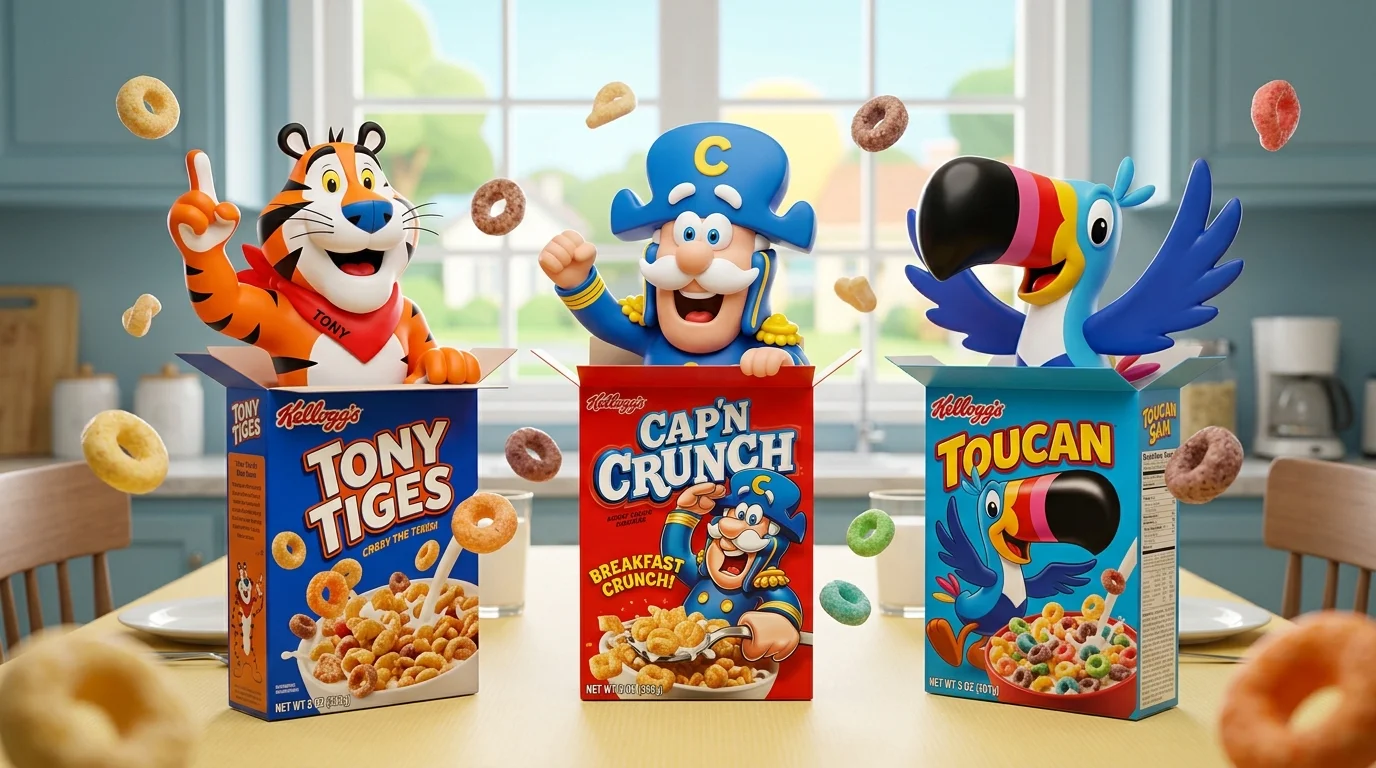
Tony the Tiger debuted in 1952 as the face of Kellogg’s Frosted Flakes, and almost immediately became the gold standard for cereal mascot design. Voiced originally by radio actor Thurl Ravenscroft, Tony embodied aspiration, athletic, encouraging, and perpetually enthusiastic. His phrase “They’re Gr-r-reat!” became one of the most recognized advertising slogans in American history.
The same decade saw the arrival of Toucan Sam (Froot Loops, 1963), Cap’n Crunch (1963), and Lucky the Leprechaun (Lucky Charms, 1964). Each character was architecturally distinct, a different species, personality archetype, and narrative hook designed to occupy a unique space in the minds of children.
The Golden Age: 1980s and 1990s Cereal Mascots
The 1980s and 1990s are widely regarded as the golden era of cereal mascot culture. Saturday morning television was at its peak, and brands invested heavily in animated shorts, merchandise, and in-box prizes all anchored around mascot identities.
For those who grew up in this period, 90s cereal mascots trigger some of the most powerful food-related nostalgia of any generation. Characters like Sonny the Cuckoo Bird (Cocoa Puffs), the Trix Rabbit, and Count Chocula weren’t just marketing figures, they were recurring characters in the lives of children, appearing weekly in commercials, on lunchboxes, in Halloween costumes, and in school yard conversations.
The 1990s also saw cereal packaging become a collectible object. Limited-edition boxes featuring holographic designs, toy prizes inside, or special mascot illustrations drove children to request specific brands at the grocery store, a powerful demonstration of mascot-driven consumer behavior.
The Most Famous Cereal Mascots of All Time
Any comprehensive exploration of cereal mascots must reckon with the characters who have achieved genuine cultural permanence. These are not simply advertising figures, they are semantic entities that appear consistently in media, academic marketing studies, consumer memory research, and popular culture.
Tony the Tiger Frosted Flakes (Kellogg’s)
Created in 1952, Tony remains the most recognized cereal mascot in the world. His visual design of an anthropomorphic tiger in a red neckerchief, standing upright and radiating confidence, communicates the brand’s core values of energy, achievement, and positivity. Decades of sports-linked advertising have reinforced this positioning. Tony the Tiger is a textbook example of character branding done right: a single mascot that has maintained brand relevance for over 70 years.
The Trix Rabbit Trix (General Mills)
Few characters in advertising history have been defined so completely by a single dramatic tension. The Trix Rabbit wants cereal. Children have cereal. The rabbit never gets it. This simple narrative loop established in 1959 created one of the most emotionally resonant mascots in breakfast cereal history. The Trix Rabbit is a study in narrative-based brand identity: consumers don’t just recognize the character, they remember a story.
Toucan Sam Froot Loops (Kellogg’s)
Debuting in 1963, Toucan Sam distinguishes himself through sensory branding. His enormous, rainbow-striped beak is both a visual cue for the fruity flavor profile of Froot Loops and a narrative device. Sam follows his nose to fruity flavors. The character is a masterclass in synesthetic marketing: making a visual character communicate taste and smell.
Snap, Crackle & Pop Rice Krispies (Kellogg’s)
This trio, first appearing in the 1930s, is unique among cereal mascots in that they are named after the product’s sensory experience rather than a personality trait or adventure motif. Snap, Crackle, and Pop are small elf-like figures that embody the sounds of the cereal itself, turning an auditory product feature into a set of beloved characters. They represent one of the earliest examples of multi-character mascot marketing.
Cap’n Crunch Cap’n Crunch (Quaker Oats)
Launched in 1963, Cap’n Crunch is a naval captain with an oversized hat, a luxuriant mustache, and an adventurous spirit. His character draws from seafaring mythology and children’s adventure narratives, positioning a bowl of cereal as the start of a voyage. The Cap’n is a strong example of world-building in brand mascot design; the character comes with an implied universe of ships, seas, and discovery.
Lucky the Leprechaun Lucky Charms (General Mills)
Introduced in 1964, Lucky has become the definitive St. Patrick’s Day advertising figure in American culture. His association with magical marshmallow shapes, hearts, stars, horseshoes, and more created a product mythology that is inseparable from the mascot himself. Lucky’s popularity also demonstrates the power of culturally coded mascots: characters that tap into existing folklore and mythology.
Count Chocula Count Chocula (General Mills)
Count Chocula is perhaps the most effective example of seasonal mascot marketing. As a vampire with a sweet tooth for chocolate cereal, he became the quintessential Halloween breakfast icon, creating a product moment that recurs every year without requiring new creative investment. The Count demonstrates how a well-designed mascot can own a cultural calendar moment.
BuzzBee Honey Nut Cheerios (General Mills)
BuzzBee is a relatively recent mascot entrant but one of the most commercially successful. As the cheerful honeybee face of Honey Nut Cheerios, one of the best-selling cereals in the United States BuzzBee has achieved mainstream mascot status while also becoming associated with real-world environmental messaging around bee population decline. This dual role as brand mascot and conservation symbol reflects the modern evolution of cereal character branding.
Lesser-Known Cereal Mascots Worth Knowing
Beyond the household names, the world of breakfast cereal characters is populated by dozens of fascinating figures that deserve recognition.
CinnaMon and Bad Apple represent the cinnamon and apple flavor profiles of Apple Jacks through a quirky character rivalry, an early example of adversarial mascot pairs used to dramatize flavor contrast.
Dig’em Frog is the energetic, streetwise frog at the center of Honey Smacks (Kellogg’s) advertising, a character with surprising longevity who has gone through multiple visual redesigns while maintaining core personality traits.
Cornelius “Corny” Rooster, the Corn Flakes mascot, is one of the most quietly enduring figures in cereal history, a natural-world animal whose early-rising associations perfectly match the breakfast occasion.
Big Yella, the cowboy-themed mascot of Corn Pops, represents a category of regional and era-specific mascots whose cultural moment has faded but whose design logic remains instructive.
Sugar Bear, the impossibly cool, honey-loving bear behind Golden Crisp (Post), is a mascot archetype built around effortless coolness rather than enthusiasm, a rarer personality model in cereal branding.
Cereal Mascots and the Representation Gap: Female Characters
One of the most discussed critiques in modern cereal mascot discourse is the near-total dominance of male characters. The vast majority of iconic cereal mascots Tony, Cap’n Crunch, Lucky, Sonny, the Trix Rabbit, BuzzBee are male-coded characters.
Female cereal mascots are historically rare. Pebbles Flintstone, Fred Flintstone’s daughter who appears on the Fruity and Cocoa Pebbles packaging (Post), is one of the few recognizable female figures in the category. In some historical versions of Kellogg’s Rice Krispies advertising, Crackle from the Snap, Crackle & Pop trio has been depicted with female-coded characteristics, though this has never been the dominant interpretation.
The underrepresentation of female cereal mascots is not only a cultural observation it is a brand strategy opportunity. Research in children’s advertising consistently shows that children of all genders connect more broadly with diverse character rosters. Brands that introduce well-designed, personality-rich female mascot characters stand to expand emotional reach and modernize brand perception.
The Psychology Behind Cereal Mascot Design
Understanding why cereal mascots work requires a brief look at the psychological mechanisms they engage.
Anthropomorphism is the foundational mechanism. Humans are neurologically wired to perceive faces, emotions, and social intentions even in non-human entities. When a tiger smiles or a rabbit schemes, our brains engage the same social cognition systems we use for real human relationships making mascot characters instantly legible to young children.
Narrative engagement amplifies anthropomorphism. Characters like the Trix Rabbit and Lucky the Leprechaun exist within ongoing stories. These narrative loops keep children emotionally engaged across multiple advertising exposures.
Parasocial bonding occurs when repeated exposure creates a felt sense of familiarity. Children who watch Cap’n Crunch commercials develop a form of affection that feels genuinely relational, and that bond transfers directly to the product.
Distinctive asset design ensures that color, shape, and visual signature trigger brand recognition without requiring a logo or name, such as Toucan Sam’s rainbow beak, Tony’s orange stripes, Count Chocula’s purple cape.
Cereal Mascots in the Modern Era
The media landscape of the 2020s has fundamentally changed how cereal mascots reach audiences. Saturday morning cartoon blocks are largely a memory. Today’s children consume content through streaming platforms, YouTube, TikTok, and gaming environments.
Forward-thinking cereal brands have adapted their mascots accordingly, Tony the Tiger in social media campaigns, the Trix Rabbit reimagined in short-form video, and several brands introducing limited-edition mascot packaging tied to streaming properties and cultural moments.
Custom printed cereal boxes have emerged as a significant sub-category of this evolution. As digital printing technology has lowered the cost of short-run specialty packaging, brands can produce limited-edition mascot artwork and seasonal character designs that create the same collector excitement as the holographic boxes of the 90s faster and more affordably than ever.
Quick-Reference: Iconic Cereal Mascots at a Glance
| Mascot | Brand | Manufacturer | Core Trait | Era |
| Tony the Tiger | Frosted Flakes | Kellogg’s | Athletic, encouraging | 1952 |
| The Trix Rabbit | Trix | General Mills | Determined, perpetually thwarted | 1959 |
| Toucan Sam | Froot Loops | Kellogg’s | Adventurous, sensory-led | 1963 |
| Cap’n Crunch | Cap’n Crunch | Quaker Oats | Nautical, world-builder | 1963 |
| Lucky the Leprechaun | Lucky Charms | General Mills | Clever, magical | 1964 |
| Snap, Crackle & Pop | Rice Krispies | Kellogg’s | Sound-themed trio | 1930s |
| Count Chocula | Count Chocula | General Mills | Halloween icon | 1971 |
| Sonny the Cuckoo Bird | Cocoa Puffs | General Mills | Manic, cocoa-obsessed | 1962 |
| BuzzBee | Honey Nut Cheerios | General Mills | Friendly, eco-conscious | 1979 |
| Sugar Bear | Golden Crisp | Post | Cool, laid-back | 1963 |
| Dig’em Frog | Honey Smacks | Kellogg’s | Outgoing, energetic | 1972 |
| Cornelius Rooster | Corn Flakes | Kellogg’s | Reliable, early-rising | 1957 |
Final Thoughts: The Enduring Power of the Cereal Character
From the Quaker Man in 1877 to Tony the Tiger’s social media presence in the 2020s, cereal mascots have demonstrated a remarkable capacity to endure. They survive cultural shifts, media revolutions, and generational turnover because they are built on something more durable than any advertising campaign: emotional memory.
The child who reached for Frosted Flakes because Tony told them they were Gr-r-reat grows up into an adult who feels a flicker of warmth when they see that orange stripe in the cereal aisle. The parent who buys Lucky Charms for their own child is, in part, buying a piece of their own childhood.
That is the deepest truth about cereal mascots. They are not just characters they are memory anchors, designed with extraordinary care to attach themselves to the happiest, most unguarded moments of human experience: early mornings, the smell of milk and cereal, the feeling of a Saturday with nowhere to be.
In a world of fragmented attention and ephemeral digital content, there is something quietly remarkable about a character who has been showing up at the breakfast table, unchanged in spirit, for over 70 years.
CustomPrintedPaper explores the intersection of packaging design, brand identity, and print culture.
Also Read: https://customprintedpaper.com/blog/how-much-do-cigarettes-cost-in-2026-state-by-state-price-guide/