







Cigarette Size Chart: Every Dimension, Standard & Regulation You Need to Know
May 12, 2026 Explore Blogs
If you’ve ever held two cigarette packs side by side and noticed they weren’t quite the same size, you weren’t imagining it. Cigarette dimensions, from the length of the tobacco rod to the depth of the carton, follow a surprisingly precise system of global industry standards and government-mandated regulations.
This guide breaks down every measurement you need: individual cigarette lengths and diameters, pack dimensions across all sizes, carton configurations, filter sizes by brand, and the country-specific packaging laws reshaping the industry in 2026. Whether you’re a consumer, a packaging professional, a retailer, or a compliance researcher, this is the most complete cigarette size reference available.
Why Cigarette Sizes Are More Standardized Than You Think
Most people assume tobacco companies design their products based on brand preference alone. The reality is more structured. Cigarette dimensions are governed by a combination of manufacturing efficiency, consumer psychology research developed over decades, and, increasingly, government regulation.
Three key entities define cigarette sizing globally:
- Tobacco manufacturers (Philip Morris International, British American Tobacco, Japan Tobacco International)
- National regulatory bodies (FDA in the US, MHRA in the UK, TGA in Australia)
- The WHO Framework Convention on Tobacco Control (FCTC), which 182 countries have ratified
Understanding these dimensions matters for consumers who want to compare products accurately, retailers managing inventory, and packaging designers working within compliance requirements.
The Complete Cigarette Size Chart
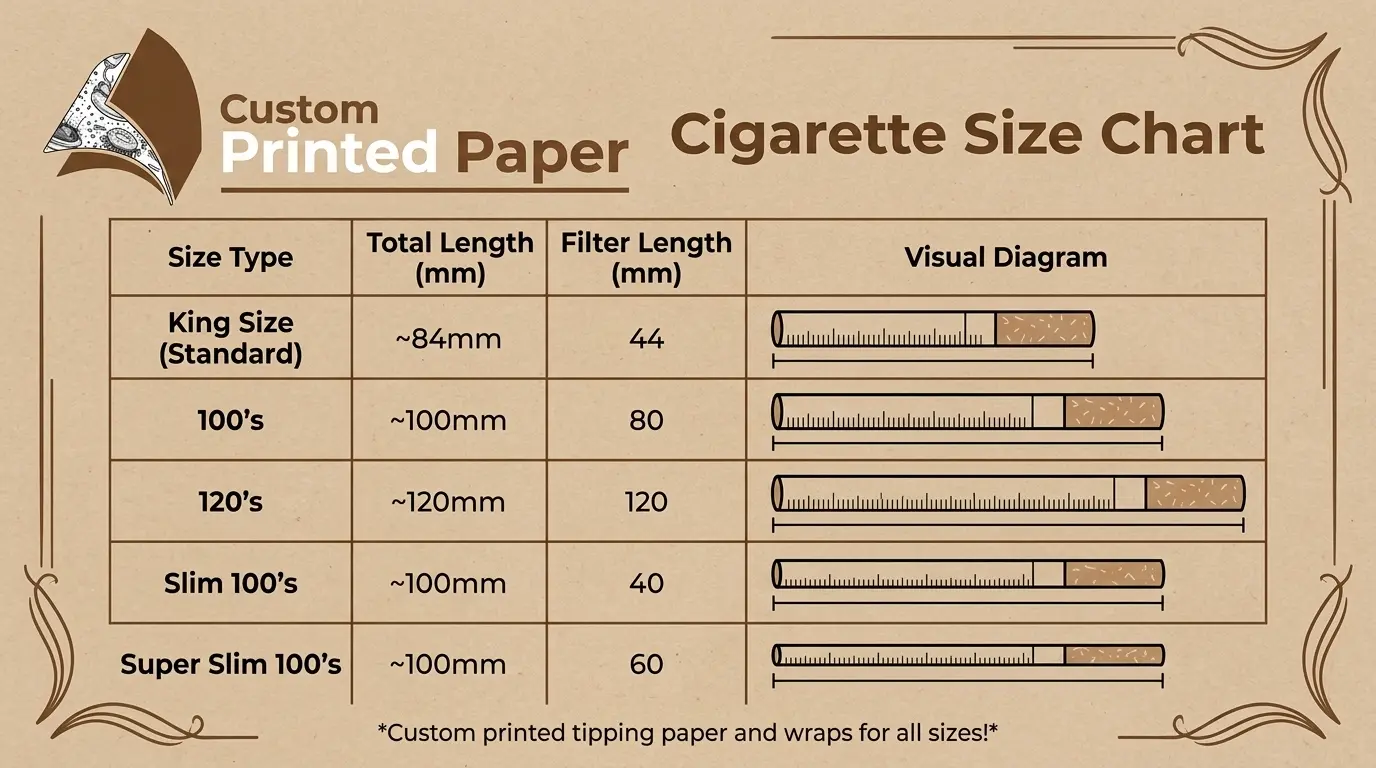
Here is the definitive cigarette length and diameter reference chart for 2026:
| Cigarette Type | Length | Diameter | Tobacco Weight | Notes |
| Regular | 70mm (2.75 in) | 7.8–8.0mm | ~0.65g | Legacy standard, largely phased out |
| King Size | 84mm (3.31 in) | 7.8–8.0mm | 0.7–0.8g | Current global default |
| 100s | 100mm (3.94 in) | 7.8–8.0mm | ~0.9g | Popular in North America |
| 120s | 120mm (4.72 in) | 7.8–8.0mm | ~1.1g | “Extra long,” niche market |
| Slim | 84–100mm | 5.4–6.0mm | 0.5–0.6g | 25% thinner than regular |
| Super Slim | 84–100mm | 5.0–5.1mm | ~0.4g | Ultra-thin, fast smoke flow |
King Size: The 84mm Global Standard
King Size cigarettes, measuring exactly 84mm in length with a 7.8–8.0mm diameter, became the dominant format during the 1960s and 1970s when the original 70mm “regular” cigarette was gradually replaced. The shift was driven by consumer preference for a longer smoke and by marketing positioning that associated length with quality.
Today, King Size is the manufacturing default for virtually every major tobacco brand worldwide. Each cigarette holds 0.7–0.8 grams of tobacco, producing a consistent burn time that became the benchmark for the industry.
100s and 120s: The Extended Length Options
100s cigarettes stretch to 100mm (3.94 inches) while maintaining the same 7.8–8.0mm diameter as King Size. They hold approximately 0.9 grams of tobacco. These remain especially popular in the United States and parts of Latin America, where the longer format is associated with premium positioning.
120s cigarettes reach 120mm (4.72 inches), informally described as “the longest standard cigarette in the world.” Their full packaging dimensions are 199mm × 55mm × 20mm. At 1.1 grams of tobacco, they offer the longest single-cigarette experience commercially available.
Slim and Super Slim Cigarettes: Diameter Differences Explained
Slim and super slim cigarettes maintain the same lengths as King Size or 100s, but are significantly narrower:
- Slim cigarettes (5.4–6.0mm diameter) are approximately 25% thinner than a standard cigarette. The reduced circumference, typically around 21mm versus the standard 26mm results in a measurably faster smoke flow and roughly 20% less carbon monoxide per puff due to altered combustion dynamics.
- Super slim cigarettes (5.0–5.1mm diameter) are the narrowest commercially produced format. Research has shown that super slim cigarettes move smoke more than twice as fast as standard cigarettes, which changes the sensory experience entirely.
- Both formats hold less tobacco: slim cigarettes contain 0.5–0.6 grams, while super slims carry just 0.4 grams per cigarette.
Cigarette Filter Size Chart by Brand and Format
Filters are as precisely engineered as the tobacco rods themselves. Here’s how they break down:
| Filter Type | Diameter | Best For |
| Standard | 8mm | Pre-rolled cigarettes (all major brands) |
| Ultra Slim | 5.3mm | Roll-your-own |
| Micro | 4.6mm | Smallest commercially available |
Brand-level differences are real and measurable. Marlboro filters measure 24.8mm in circumference. Virginia Slims use a narrower 23mm circumference filter , a deliberate design choice tied to the brand’s slim-format identity.
Standard 20-Pack Dimensions (North America vs. Global)
The 20-cigarette pack is the global standard format. In North America, it typically measures:
- 3.5 × 2.25 × 0.88 inches (standard)
- Some brands: 3.63 × 2.83 × 0.83 inches
In metric (used by global manufacturers):
| Pack Size | Dimensions (mm) | Dimensions (inches) |
| 20-pack (standard) | 88 × 57 × 22mm | 3.46 × 2.24 × 0.87 in |
| 20-pack (King Size) | 96 × 58 × 23mm | 3.78 × 2.28 × 0.91 in |
| 10-pack | 89 × 42 × 18mm | 3.50 × 1.68 × 0.71 in |
| 5-pack | 89 × 41 × 11mm | 3.50 × 1.63 × 0.45 in |
Regular vs. King Size Pack: Side-by-Side Comparison
| Feature | Regular Pack | King Size Pack |
| Dimensions | 83 × 55 × 20mm | 85 × 58 × 20mm |
| Cigarettes per pack | 20 | 25 |
| Standard format | Yes | Yes (dominant) |
The King Size pack’s slightly larger footprint, just 2mm taller and 3mm wider, is engineered to accommodate the longer cigarette without wasting material or making the pack unwieldy in a shirt pocket.
25-Pack and 50-Pack: Larger Format Dimensions
25-cigarette packs measure approximately 3.39 × 2.4 × 0.8 inches and are particularly common in Australia, where larger pack sizes have historically been permitted. The cost-per-cigarette advantage over 20-packs makes them popular with regular smokers.
50-cigarette packs measure approximately 3.39 × 4.7 × 1.0 inches. These are used primarily for bulk retail, promotional packaging, and markets where duty-free purchasing is common. They are not pocket-friendly by design.
Cigarette Carton Dimensions: Everything in One Place
| Configuration | Packs per Carton | Total Cigarettes | Carton Dimensions |
| Standard (US/EU) | 10 packs | 200 cigarettes | ~6 × 3 × 8 inches |
| Japanese market | 25 packs | 500 cigarettes | Larger format |
| Mini carton | 5 packs | 100 cigarettes | Compact format |
The standard carton , 10 packs of 20 cigarettes , has been the distribution norm in most Western markets for decades. The 6 × 3 × 8 inch carton footprint is optimized for shelf stacking, point-of-sale display, and logistics efficiency.
Japan is a notable exception: cartons there sometimes contain 25 packs, producing a 500-cigarette configuration that reflects different retail purchasing behavior in that market.
Country-Specific Packaging Regulations You Must Know
The Global Plain Packaging Movement
Australia became the first country in the world to mandate plain packaging in December 2012 , a move that fundamentally changed the global tobacco packaging landscape. The Australian framework established specifications that many subsequent laws have replicated:
- Color: Pantone 448C (a dark olive-brown, widely described as “the world’s ugliest color”)
- Typography: Brand names in Lucida Sans or Helvetica, maximum 14-point size
- Prohibited: All logos, brand imagery, embossing, decorative foil, distinctive shapes
Countries that followed with their own plain packaging legislation:
| Country | Plain Packaging Law Enacted |
| Australia | December 2012 |
| France | January 2016 |
| United Kingdom | May 2017 |
| Ireland | September 2017 |
| Canada | November 2019 |
As of 2026, 25 countries have active plain packaging requirements, with 14 more , including Botswana, Colombia, and South Africa , in various stages of legislative consideration.
Minimum and Maximum Pack Sizes by Country
Governments don’t just regulate appearance , they regulate quantity too:
| Country/Region | Minimum Pack Size | Maximum Pack Size | Notes |
| European Union | 20 cigarettes | No upper limit specified | EU Tobacco Products Directive |
| United Kingdom | 20 cigarettes | No upper limit | Banned 10-packs in May 2017 |
| Russia | 20 cigarettes | 20 cigarettes | Only 20-pack permitted |
| Georgia | 20 cigarettes | 20 cigarettes | Only 20-pack permitted |
| New Zealand | 20 cigarettes | 25 cigarettes | Only these two sizes |
| Australia | 20 cigarettes | 50 cigarettes | Multiple quantities allowed: 20–50 |
| United States | No federal minimum | No federal maximum | State-level variation exists |
Australia’s permissive upper limit , allowing packs of 20, 21, 22, 23, 25, 26, 30, 35, 40, 43, or 50 cigarettes , is unique globally and reflects a deliberate policy decision to allow manufacturers flexibility while still enforcing plain packaging standards.
WHO FCTC Compliance Standards
The WHO Framework Convention on Tobacco Control sets the international baseline that domestic legislation builds upon. Current FCTC-aligned packaging requirements include:
- Rectangular packs with 90-degree angles only
- Flip-top lid construction (no slide packs, no round-cornered packs)
- No sound-emitting or scent-releasing packaging features
- Pictorial health warnings (now required in 138 countries, reaching an estimated 66.5% of the global population)
These requirements shape not just the appearance of cigarette packaging but its physical dimensions, since any deviation from the rectangular, flip-top format requires specific regulatory approval.
Conclusion: Why These Dimensions Matter Beyond the Pack
Every millimetre of a cigarette, from the 84mm tobacco rod to the 8mm filter diameter, exists because of a deliberate decision made somewhere between a boardroom, a laboratory, and a legislative chamber. These aren’t arbitrary numbers. They represent decades of manufacturing optimization, consumer behavior research, and increasingly aggressive public health policy.
For consumers, understanding these dimensions helps decode product differences that brands rarely advertise plainly. For retailers and distributors, knowing pack and carton dimensions precisely is essential for inventory planning, shelf allocation, and compliance. For packaging professionals and researchers, this system of global standards forms the framework within which all tobacco packaging decisions are made.
The trend line is clear: more countries are adopting plain packaging, minimum pack sizes are being raised, and the physical freedom manufacturers once had to differentiate through packaging is narrowing every year. By 2030, the cigarette pack as a branding vehicle may be nearly extinct in regulated markets.
Need Custom Cigarette Packaging Printed to Exact Specifications?
If you’re a manufacturer, retailer, or brand requiring precision-printed cigarette packaging that meets current regulatory standards , including plain packaging compliance, exact dimensional tolerances, and high-quality print finishes , Printed Papers delivers exactly that.
We produce:
- Regulation-compliant cigarette packs (20-pack, 25-pack, and custom counts)
- Carton packaging sized to your distribution specifications
- Custom print runs with Pantone color matching, foil, and emboss options where legally permitted
- Plain packaging compliance print solutions for UK, AU, CA, and EU markets
Get a Custom Quote from CustomPrintedPaper
Whether you need a short print run or large-scale production, our team works to your exact dimensional and compliance requirements.
Talk to a packaging specialist today
Frequently Asked Questions
Q: What are the standard dimensions of a cigarette pack in 2026?
A standard 20-pack measures 3.5 × 2.25 × 0.88 inches (approximately 88 × 57 × 22mm) in North America. King Size packs run slightly larger at 3.8 × 2.3 × 0.9 inches to accommodate the longer cigarette.
Q: How long is a standard cigarette?
In size, the current global standard measures 84mm (3.31 inches). Regular cigarettes were 70mm but are largely discontinued. Extended formats include 100s (100mm) and 120s (120mm).
Q: What is the difference between slim and super slim cigarettes?
Slim cigarettes are 5.4–6.0mm in diameter, about 25% thinner than a regular cigarette. Super slim cigarettes are even narrower at 5.0–5.1mm. Both formats produce faster smoke flow and hold less tobacco than standard cigarettes.
Q: How many cigarettes are in a carton?
A standard carton in the US and EU contains 10 packs of 20 cigarettes, totaling 200 cigarettes. In Japan, cartons sometimes hold 25 packs (500 cigarettes total).
Q: What are plain packaging regulations?
Plain packaging laws require tobacco products to be sold in standardized packaging, typically a mandated color (Pantone 448C in most jurisdictions), no brand logos, and strictly controlled typography. As of 2026, 25 countries enforce plain packaging, with more in the legislative pipeline.
Q: What filter size do most cigarettes use?
Standard pre-rolled cigarettes use 8mm diameter filters. Roll-your-own formats use thinner filters: Ultra Slim (5.3mm) and Micro (4.6mm) are the most common alternatives.