







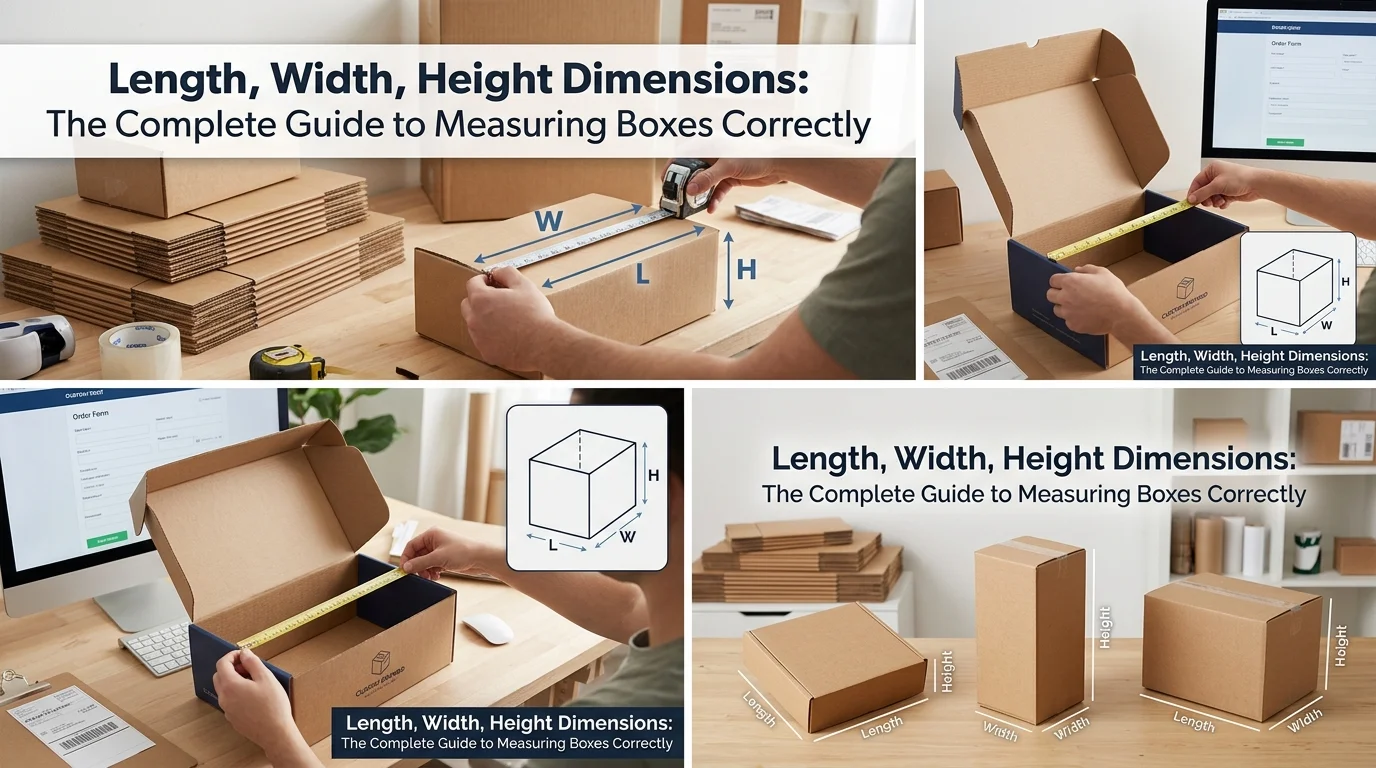
Length, Width, Height Dimensions: The Complete Guide to Measuring Boxes Correctly
July 30, 2026 Explore Blogs
Getting a box’s dimensions wrong is one of those mistakes that seems minor until it isn’t. A box that’s two inches too wide wastes material, inflates shipping costs, and lets your product shift around in transit. A box that’s a fraction too small means a damaged product, a frustrated customer, and a return that eats into your margins.
Dimensions length, width, and height are the three numbers that determine whether your packaging actually does its job. Whether you’re sourcing custom boxes for a product launch, calculating shipping costs for a fulfillment operation, or simply trying to understand what those numbers in a product listing actually mean, this guide covers everything you need to know.
What Are Length, Width, and Height in Packaging?
In packaging, every physical box is a three-dimensional object measured along three axes. These three measurements length, width, and height — together define the box’s size, volume, and dimensional weight for shipping purposes.
Here’s what each measurement actually refers to:
Length is the longest side of the box’s base, the measurement that runs from one end of the bottom face to the other at its widest horizontal point.
Width is the shorter side of the box’s base perpendicular to the length, also measured along the bottom face of the box.
Height (sometimes called depth) is the vertical measurement the distance from the base of the box to its top opening.
The standard formula for recording box dimensions follows this order: Length × Width × Height (L × W × H). This is the industry convention used by packaging manufacturers, logistics carriers, and warehouse management systems worldwide.
Why Box Dimensions Matter More Than Most People Realise
Product Protection
A correctly dimensioned box is a snug box. When your product fits properly — with minimal excess space inside it has nowhere to shift during transit. Movement is one of the primary causes of damage during shipping. A box with too much internal space requires void fill to compensate, adding material cost and assembly time. A box with too little space risks compressing or deforming the product.
Getting dimensions right at the design stage means your product arrives in the condition it left you consistently, at scale.
Shipping Cost Control
Major logistics carriers including FedEx, UPS, and DHL use a pricing methodology called dimensional weight (also known as DIM weight or volumetric weight). Under this system, the shipping cost is calculated based on whichever is greater: the package’s actual weight, or its calculated dimensional weight which is derived from the box’s volume divided by a carrier-specific divisor.
This means an oversized, lightweight box can cost significantly more to ship than its actual weight would suggest. Precise box dimensions directly control your dimensional weight and, by extension, your per-unit shipping cost is a variable that compounds quickly at any meaningful volume.
Storage and Space Efficiency
In warehouse environments, box dimensions determine how efficiently stock can be palletised, racked, and stored. Boxes with irregular or unnecessarily large dimensions waste cubic storage space, reduce pallet density, and complicate inventory management. Precisely dimensioned packaging stacks predictably, maximises space utilisation, and makes warehouse operations measurably more efficient.
The Standard Order of Box Dimensions: L × W × H
The universally accepted standard for recording and communicating box dimensions is Length × Width × Height in that order. This is the format used by packaging suppliers, shipping carriers, and e-commerce platforms.
When you see a box listed as 16″ × 12″ × 8″, that means:
- Length: 16 inches (longest base dimension)
- Width: 12 inches (shorter base dimension)
- Height: 8 inches (vertical dimension)
This order is a convention, not a physical law. The box itself doesn’t change depending on how you orient it. But the convention exists to ensure that everyone in a supply chain from the packaging designer to the warehouse operative to the carrier is reading and applying the same numbers the same way.
Alternative Dimension Orders and When They Apply
While L × W × H is standard, certain industries, product types, and packaging orientations use different measurement orders. Understanding these variations prevents confusion when working across different suppliers or markets.
Height × Width × Length (H × W × L)
This order is commonly used for vertical boxes packaging that stands upright, where height is the most immediately apparent measurement. Tall retail boxes, display packaging, and standing product cartons are often specified this way. Measuring height first reflects how the box is naturally oriented in use.
Height × Length × Width (H × L × W)
Used for horizontal packaging where the box lies on its side. In this orientation, height (now the vertical dimension of the horizontal object) is measured first, followed by the longest horizontal dimension (length), then the shorter horizontal dimension (width).
Length × Height × Width (L × H × W)
This order is sometimes used when viewing a box from its side profile rotating it 90 degrees from the standard front-view position. The length becomes the dimension running along the base of the side view, height is measured vertically, and width (depth) becomes the remaining dimension.
The critical point is this: regardless of the order in which you measure and record dimensions, the formula for calculating volume remains the same. Volume = Length × Width × Height. The three numbers multiplied together always yield the same result.
How to Calculate Box Volume
Box volume also called cubic size or cubic capacity is used to calculate dimensional weight for shipping and to assess how much product a box can physically contain.
The formula is straightforward:
Volume = Length × Width × Height
As a practical example: a standard shipping box measuring 16 inches in length, 12 inches in width, and 12 inches in height has a volume of:
16 × 12 × 12 = 2,304 cubic inches
To convert to cubic feet (often required for pallet and freight calculations), divide cubic inches by 1,728.
2,304 ÷ 1,728 = 1.33 cubic feet
For dimensional weight calculations, most major carriers use a divisor of 139 (for international shipments) or 166 (for domestic US shipments). Divide your cubic inch volume by the applicable divisor to get the dimensional weight in pounds.
2,304 ÷ 139 = approximately 16.6 lbs dimensional weight
If the actual package weighs less than 16.6 lbs, the carrier charges based on dimensional weight not actual weight.
Two-Dimensional vs. Three-Dimensional Packaging
Not all packaging is cubic. Understanding the distinction between 2D and 3D packaging is useful when selecting the right format for different product types.
Two-dimensional packaging has only length and width no meaningful depth or height. This category includes envelopes, flat mailers, poly bags, and rigid mailers used for documents, photographs, prints, certificates, and thin flat items. Volume calculations don’t apply, but length and width still determine material usage and postage classification.
Three-dimensional packaging the focus of this guide has length, width, and height, creating internal volume. This encompasses the full range of box formats: shipping cartons, retail boxes, folding cartons, mailer boxes, display boxes, and custom packaging of every configuration. Three-dimensional packaging is subject to dimensional weight pricing and requires all three measurements to be accurately specified.
Internal vs. External Dimensions: A Critical Distinction
One of the most consequential and most commonly overlooked distinctions in box measurement is the difference between internal dimensions and external dimensions.
Internal dimensions measure the usable space inside the box the cavity that your product actually occupies. These measurements account for the thickness of the box’s walls, which varies depending on the board grade, material, and construction.
External dimensions measure the outer physical footprint of the assembled box, including wall thickness on all sides.
For product packaging purposes, internal dimensions are the measurements that matter. When you specify a box for a product, you need to know that the product will fit inside the box which means measuring against internal dimensions, not external ones.
The gap between internal and external dimensions depends on the board stock being used. A single-wall corrugated box might add approximately 3–4mm per wall in each direction. A double-wall corrugated box might add 6–7mm. For rigid boxes and folding cartons, the difference is typically smaller but still present.
When requesting quotes from packaging manufacturers, always clarify whether the dimensions quoted are internal or external. The industry standard for custom packaging is to quote internal dimensions but this is not universal across all suppliers.
Length vs. Width: What’s the Practical Difference?
The distinction between length and width can be counterintuitive because both measurements describe the base of the box the horizontal plane.
The clearest practical rule: length is always the longer of the two base dimensions; width is always the shorter. In a square base box, length and width are equal, making the distinction moot.
Where the distinction becomes meaningful is in how boxes are oriented on pallets, in racking systems, and in printed artwork layouts. A box specified as 300mm (L) × 200mm (W) will be palletised differently than a box specified as 200mm (L) × 300mm (W) even though the numbers are the same, the orientation convention changes how the box is positioned in a stack.
For custom printed packaging, the distinction also affects artwork orientation. The face of a box with the greatest area typically the face defined by length and height is usually where primary branding, product imagery, and key information appear.
How to Measure a Box Correctly: Step-by-Step
Accurate measurement requires the right approach and the right tools.
Tools you’ll need: A rigid ruler or metal tape measure for most boxes. A flexible measuring tape for irregular shapes or circumferences. Digital calipers for precise measurement of wall thickness or small mailer boxes where millimetre accuracy matters.
Step-by-step process for a standard rectangular box:
Open the box fully and lay it flat if measuring an unassembled blank or assemble it fully if measuring an assembled box. Measuring a collapsed box introduces error because walls may not be fully squared.
Measure the longest dimension along the base, from interior wall to interior wall. This is your length. Record it.
Measure the shorter dimension along the base, perpendicular to your length measurement, from interior wall to interior wall. This is your width. Record it.
Measure vertically from the interior base of the box to the top edge. This is your height. Record it.
Record your measurements in the standard format: L × W × H, in your preferred unit (inches or millimetres). For packaging orders and shipping purposes, always double-check the unit system mixing inches and millimetres is a common source of costly errors.
A Practical Reference: Common Box Dimensions by Type
| Box Type | Typical L × W × H | Common Use |
| Small mailer box | 6″ × 4″ × 2″ | Jewellery, accessories, small products |
| Medium mailer box | 12″ × 9″ × 4″ | Apparel, books, flat-packed items |
| Standard shipping carton | 16″ × 12″ × 12″ | General e-commerce fulfilment |
| Large shipping carton | 24″ × 18″ × 18″ | Bulky items, multi-unit packs |
| Retail folding carton (small) | 4″ × 2″ × 6″ | Cosmetics, small consumer goods |
| Standard cereal/food box | 7.5″ × 2″ × 12″ | Packaged food products |
| Pizza box (medium) | 12″ × 12″ × 2″ | Food service, flat products |
Note: These are representative dimensions. Always specify custom dimensions for your particular product requirements.
Common Dimension Mistakes and How to Avoid Them
Measuring the outside instead of the inside. Always measure internal dimensions for packaging specifications. External measurements will result in a box too small for your product.
Forgetting to account for product orientation. A product that is 10cm tall when upright but 25cm long when lying on its side needs to be packed in its intended orientation. Measure the product as it will sit in the box.
Ignoring void fill space. For fragile products requiring cushioning, build the necessary clearance into your dimension specification. A product measuring 10 × 8 × 5cm may require a box of 14 × 12 × 9cm to accommodate protective inserts.
Mixing measurement units. Always confirm whether your supplier quotes in inches or millimetres, and use consistent units throughout. A box ordered in the wrong unit system will be catastrophically wrong.
Confusing length and width on non-square bases. For rectangular bases, always assign length to the longer dimension and width to the shorter even if your product sits differently inside.
Dimensions and the Bigger Picture of Packaging Design
Understanding length, width, and height is the essential foundation of packaging specification but it’s one element within a broader design and logistics system.
Accurate dimensions feed into material selection (heavier board for larger, heavier boxes), structural design (where score lines, fold allowances, and tab dimensions are calculated from the internal dimensions), print artwork preparation (where the die-line template is built around the box’s unfolded flat dimensions), and logistics planning (where dimensional weight, pallet configurations, and storage racking are all derived from box measurements).
Getting dimensions right at the start of a packaging project prevents costly errors at every subsequent stage. A dimension specified incorrectly before a print run results in wasted stock. A dimension calculated incorrectly before a carrier agreement results in unexpected shipping costs. A box sized incorrectly before a product launch results in customer complaints and returns.
Three numbers. Measured carefully. Recorded correctly. The foundation on which every successful packaging project is built.
CustomPrintedPaper covers packaging design, print production, and everything in between from specification fundamentals to high-end finishing techniques.
Also Read: https://customprintedpaper.com/blog/what-is-flocking/