



What Is Flocking? The Complete Guide to Flocked Packaging for Small Businesses
July 21, 2026 Explore Blogs
There is a moment — specific and unmistakable — when a customer lifts a box, runs their thumb across the surface, and pauses. That pause is what flocking creates. It is the difference between packaging that is looked at and packaging that is felt, remembered, and talked about.
Flocking is one of the most tactilely distinctive finishing techniques available in custom packaging, yet it remains poorly understood outside the luxury sector. This guide explains exactly what flocking is, how the process works at a technical level, which fiber types and substrates produce which results, when flocking is the right choice for your brand, and how it compares to competing premium finishes — everything a business owner needs to make an informed packaging decision.
What Is Flocking?
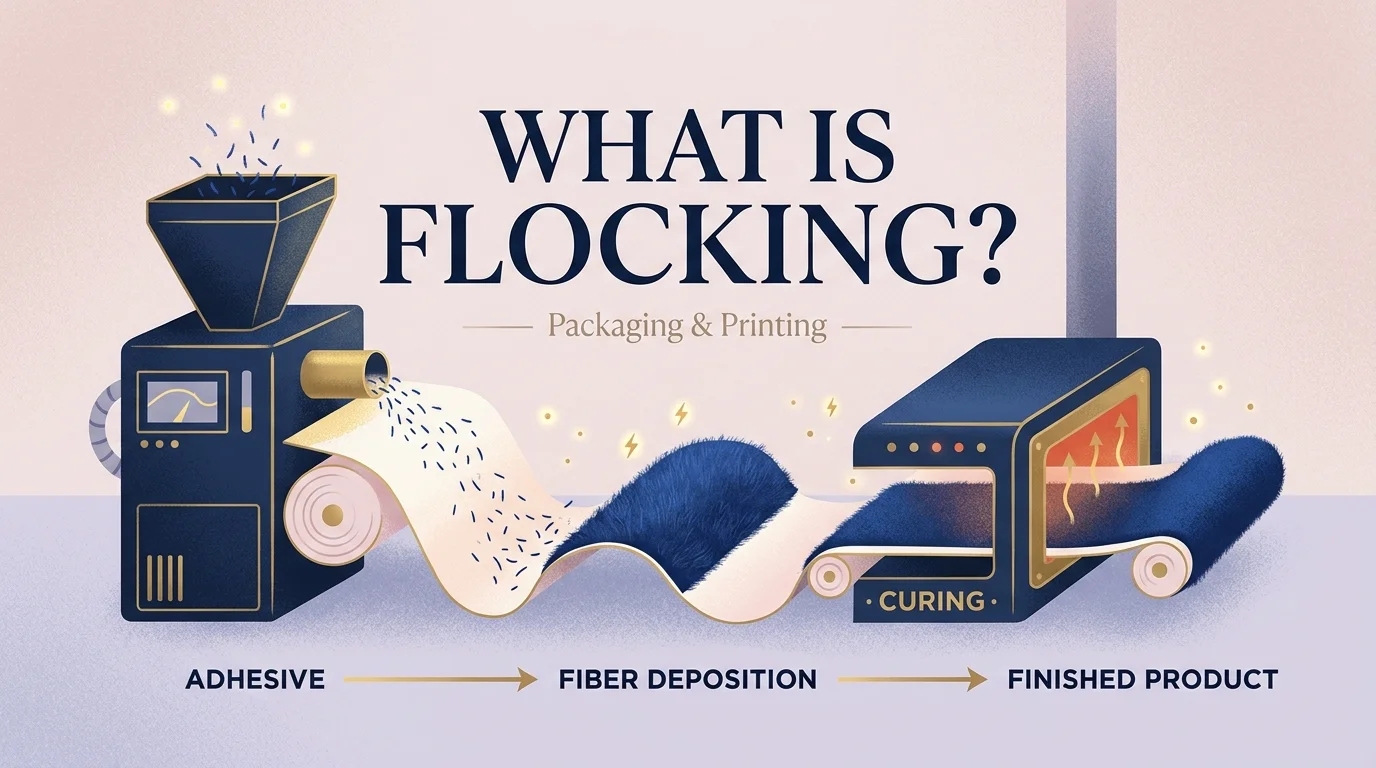
Flocking is a surface finishing technique in which millions of microscopic fibers — called flock fibers — are applied to an adhesive-coated substrate to create a soft, dense, velvet-like texture. The fibers stand perpendicular to the surface, tightly packed and uniformly oriented, producing a finish that resembles suede, velvet, or felt depending on fiber type and length.
The result is simultaneously visual and physical: a deep, matte color saturation that absorbs and diffuses light (eliminating surface glare), combined with a tactile quality that signals luxury, care, and quality to anyone who touches it.
In packaging, flocking is applied to rigid boxes, folding cartons, box inserts, paper bags, hang tags, and display trays. It is the finish found on the interior of high-end perfume boxes, the exterior of premium jewelry packaging, and the lid face of luxury skincare sets. When done well, it is the tactile equivalent of a brand speaking directly through your fingertips.
A Brief History of Flocking
Flocking is not a modern innovation. The technique traces back approximately 3,000 years to ancient China, where artisans applied natural fibers to lacquered surfaces to create textured decorative objects. The process reached Europe by the 12th century, when craftsmen in Nuremberg used it for wall coverings and decorative panels. By the 19th century, flocked wallpaper had become a status symbol in European interiors — its high material cost making it an explicit marker of wealth.
Industrial flocking production began around 1870, and the 20th century saw the technique migrate from interiors and textiles into automotive interiors, consumer electronics, cosmetic packaging, and retail display. The development of electrostatic flocking technology in the mid-20th century dramatically improved fiber uniformity and production speed, making the process viable for commercial packaging at scale.
Today, flocking is applied across industries where tactile premium quality is a purchasing signal — from luxury spirits and fine jewelry to premium confectionery and high-end cosmetics.
How the Flocking Process Works
Substrate Preparation and Priming
The flocking process begins long before any fiber touches the surface. The substrate — whether paperboard, rigid board, corrugated liner, plastic, or metal — must be prepared to accept both the adhesive and the fibers.
For paper-based substrates, this typically means ensuring the surface is free from oils, coatings, or contaminants that would prevent adhesive bonding. Many substrates benefit from a primer coat applied before the adhesive layer, particularly on surfaces with existing lamination (gloss, matte, or soft-touch laminates). Priming improves adhesive anchorage and prevents delamination under mechanical stress.
Adhesive Application
Once the substrate is prepared, adhesive is applied to the areas designated for flocking. In most packaging applications, this is done through screen printing or gravure printing of the adhesive — the same film-positive stencil process used in traditional screen printing — allowing the adhesive to be deposited precisely within defined design boundaries.
This selective adhesive application is what makes pattern flocking possible: applying flock only to specific areas of the box (a logo, a frame, a product silhouette) while leaving other areas unflocked, creating a multi-texture contrast. The precision of adhesive deposition directly determines the sharpness of the flocked pattern’s edges.
For full-surface flocking — covering an entire panel or interior — the adhesive is applied by roller or curtain coater for consistent, uniform coverage.
The adhesive chemistry matters significantly. Water-based adhesives with low VOC (volatile organic compound) content are now the industry standard for responsible flocking operations, replacing older solvent-based formulations. Water-based adhesives offer strong fiber retention, flexibility after curing (important for folding carton applications that must crease without cracking), and compliance with environmental and occupational health regulations.
Electrostatic Fiber Application
The dominant flocking method used in commercial packaging is electrostatic flocking. Here is how it works at a technical level:
Flock fibers are loaded into a hopper or chamber above the adhesive-coated substrate. The fibers are given a positive electrical charge by passing through or near a high-voltage electrode grid. Simultaneously, the substrate is grounded (connected to earth potential), creating a powerful electrostatic field between the charged fibers and the grounded surface.
The electrostatic field exerts a directional force on the charged fibers, propelling them vertically downward into the adhesive layer. Crucially, the fibers strike the adhesive surface at perpendicular angles — standing upright rather than lying flat — and become embedded in this orientation as the adhesive cures. This perpendicular, uniform fiber orientation is what gives electrostatic-flocked surfaces their characteristic dense, even texture.
Excess fibers that are not embedded are removed by suction, and the flocked substrate passes through a curing oven or UV curing station to set the adhesive permanently.
Alternative Methods: Beater Bar and Spray Flocking
Beater bar flocking (also called mechanical or gravity flocking) dispenses fibers from above while vibrating the substrate, allowing fibers to fall and embed randomly in the adhesive. This method produces a less uniform fiber orientation with a more textured, irregular appearance — intentionally so for applications where a rougher, more natural feel is desired. It is simpler to set up than electrostatic flocking but produces lower density and less precise results.
Spray flocking uses compressed air to propel fibers onto an adhesive-coated surface, making it practical for large-area or three-dimensional applications where electrostatic equipment cannot reach. Spray flocking produces moderate uniformity and is commonly used for automotive and industrial applications. In packaging, it is occasionally used for interior flocking of rigid boxes where all six faces need coverage.
Transfer Flocking
Pre-flocked transfer sheets are a practical alternative for small runs or designs requiring extremely fine detail. A design is flocked onto a carrier film, then heat-transferred to the final substrate using a heat press — similar in principle to heat transfer labeling. Transfer flocking allows complex multi-color flock patterns with tight tolerances and requires no adhesive setup on the substrate side, making it cost-effective for short production runs.
Flock Fiber Types: Nylon, Rayon, and Polyester
The choice of fiber material is one of the most consequential decisions in a flocking specification, yet it is rarely discussed in depth in buyer-facing content. Each fiber type produces a meaningfully different result.
Nylon Flock is the premium fiber choice. Nylon fibers are highly resilient — they spring back after compression and resist matting under repeated handling. They produce the softest, most luxurious hand-feel of any flock type, with excellent color vibrancy and brightness. Nylon flock resists abrasion well and maintains its texture under UV light exposure, making it the appropriate choice for exterior packaging surfaces that customers will handle repeatedly. It carries a higher cost premium than rayon or polyester.
Rayon Flock (also called viscose flock) is the most widely used fiber in packaging applications. It offers a softer, slightly more matte appearance than nylon and produces excellent color saturation. Rayon flock is more economical than nylon and performs well for interior box surfaces, display trays, and packaging that will be handled gently. It is less UV-stable than nylon over extended periods, making it less appropriate for retail shelf-facing exterior surfaces in high-light environments.
Polyester Flock is more resistant to moisture and humidity than both nylon and rayon, making it appropriate for packaging applications in humid environments or for products like cosmetics and bath accessories where the packaging may be exposed to steam or condensation. Polyester flock tends to feel slightly stiffer than nylon or rayon and is available in a wide range of colors including fluorescent and metallic shades.
Understanding Fiber Specifications: Dtex and Pile Height
Two technical specifications determine the character of a flocked surface: dtex (fiber thickness) and pile height (fiber length). Together they define the density, softness, and visual depth of the flock.
Dtex is the unit of fiber fineness — the weight in grams of 10,000 meters of fiber. A lower dtex value means a finer, softer fiber; a higher dtex means a coarser, stiffer one. Common flock dtex ranges for packaging applications:
- 0.9–1.7 dtex: Ultra-fine, silk-like texture. Used for luxury cosmetic inserts, jewelry box lining, and premium rigid box exteriors.
- 2.2–3.3 dtex: Standard luxury feel. The most common range for high-end retail packaging.
- 4.4–6.7 dtex: Coarser texture with higher visual pile depth. Used for display trays, automotive applications, and packaging where texture visibility matters more than softness.
Pile height (the length of the individual fiber) is measured in millimeters and typically ranges from 0.5mm to 3.0mm for packaging applications. Shorter pile (0.5–1.0mm) creates a tight, smooth velvet texture — precise and refined. Longer pile (1.5–3.0mm) produces a deeper, more plush appearance with greater visual shadow effect, though at the cost of edge definition in patterned flocking.
For most premium packaging applications, the combination of 1.0–1.7 dtex fiber at 0.5–1.0mm pile height delivers the luxury velvet finish most associated with the flocking aesthetic.
What Substrates Can Be Flocked?
Flocking can be applied to a wide range of packaging substrates, but each presents specific considerations:
Greyboard and Rigid Box Board — the most common substrate for luxury rigid box flocking — accepts adhesive exceptionally well and provides a stable, non-flexing base that prevents post-cure cracking. Both exterior and interior surfaces are regularly flocked.
Coated Paperboard (SBS/C1S/C2S) can be flocked but requires the surface coating to be either removed or primed before adhesive application, as gloss coatings repel adhesive. Soft-touch laminated paperboard, however, provides an excellent adhesive base and is frequently used as a pre-laminated substrate for flocked folding cartons.
Uncoated and Kraft Paperboard absorbs adhesive readily and is compatible with water-based adhesive systems. The resulting flock has a slightly more organic, irregular character that suits sustainable and artisanal brand aesthetics.
Plastic Substrates (PET, PVC, polypropylene) require surface treatment — typically corona treatment or priming — to create sufficient surface energy for adhesive bonding. Plastic-based flocked inserts are common in cosmetics and electronics packaging.
Corrugated Liner can be flocked on the unfluted side, typically used for premium corrugated retail display boxes. The texture of the corrugated medium can telegraph through thin liners, so heavier liner weight is recommended.
Flocking vs. Competing Premium Finishes
Small business owners sourcing luxury packaging regularly encounter several competing finishing options. Understanding when each is appropriate prevents costly misspecification.
Flocking vs. Soft-Touch Lamination: Soft-touch lamination applies a polymer film that creates a smooth, velvety surface feel through its micro-texture coating. It is significantly less expensive than flocking, can be applied uniformly across large surfaces with high speed, and provides good print protection. However, soft-touch lamination cannot match the depth of color saturation or the tactile warmth of genuine flock. For brands where premium feel is a core differentiator — fine jewelry, premium fragrance, luxury spirits — flocking is the superior choice. For brands wanting an elevated but cost-controlled finish, soft-touch lamination is the practical alternative.
Flocking vs. Velvet Lamination: Velvet lamination is a film with a micro-embossed velvet-like pattern laminated to the substrate. It approximates the look of flocking from a distance but lacks the genuine fiber depth and tactile warmth. At close range and under the touch, the difference is clear. Velvet lamination is appropriate when budget constraints make genuine flocking impractical but where a velvet aesthetic is desired.
Flocking vs. Embossing: Embossing creates raised, three-dimensional relief in the substrate itself — no fibers or coatings required. Embossing creates tactile interest through structural deformation of the board rather than surface addition. Flocking and embossing serve different purposes and are often combined: an embossed logo on a flocked background creates a multi-layered tactile hierarchy that is extremely effective in premium gifting contexts.
Flocking vs. Foil Stamping: Foil stamping adds metallic or holographic visual impact; flocking adds tactile warmth. They address different sensory dimensions and are frequently combined — a foil-stamped logo on a flocked box exterior, for example, combines visual brilliance with tactile luxury.
Design Considerations and Artwork Preparation for Flocked Packaging
Flocking requires specific artwork considerations that differ from standard print finishing:
Minimum feature size: Pattern flocking (applying flock within a specific design) requires adhesive to be deposited within the boundaries of each design element. Fine lines and small text below approximately 4–5mm in stroke width will not flock cleanly — the adhesive cannot be deposited with sufficient precision at very small scales, and fiber density at narrow line edges tends to fall away. Designs for flocking should use bold, generous shapes and text set at large point sizes.
Edge definition: The sharpness of a flocked pattern edge depends directly on adhesive application method and fiber pile height. Screen-applied adhesive with short-pile flock produces the sharpest edges. Longer pile fibers produce slightly softer, more diffused edges as individual fibers lean beyond the adhesive boundary.
Color specification: Flock fibers are dyed before application, and color matching follows fiber-specific dyeing systems rather than standard Pantone ink matching. Many fiber suppliers produce standard color ranges; custom color matching is possible but adds lead time and cost. Specify flock colors by reference to supplier swatch books rather than attempting direct Pantone translation.
Substrate color interaction: Flock color is influenced by the adhesive and substrate beneath. For maximum color vibrancy, specify a white or color-matched adhesive and, where possible, a substrate color that supports rather than undermines the flock color (a dark flock on a dark substrate produces a deep, tonal effect; the same flock on a light substrate produces a brighter, more contrasted result).
Durability and Care Considerations
Flocked packaging is durable within its intended use context, but has specific vulnerabilities buyers should understand:
Abrasion resistance varies by fiber type. Nylon flock resists matting under repeated friction far better than rayon. For packaging that will be handled frequently during retail display or gifting, specify nylon fiber for exterior-flocked surfaces.
Moisture sensitivity: Rayon flock can absorb moisture in high-humidity environments, causing fiber clumping and adhesive softening. For packaging destined for humid climates or moisture-exposed environments, polyester flock with a water-resistant adhesive system is the appropriate specification.
UV stability: Rayon flock can experience color shift under prolonged UV light exposure. Nylon flock is significantly more UV-stable. For retail display boxes in window or under direct lighting conditions, specify nylon fiber and UV-stable dyes.
Cleaning: Flocked surfaces should never be rubbed aggressively or exposed to liquid cleaners. Light dust can be removed with a soft brush. Compressed air is effective for removing loose particles from interior flocked inserts.
Sustainability in Flocking
Environmental responsibility in flocking is achievable and increasingly expected by brand owners committed to sustainability credentials.
Fiber sourcing: Rayon (viscose) flock is derived from cellulose — a natural, renewable raw material — making it a lower-impact choice than petroleum-derived nylon or polyester. Certified rayon flock produced from FSC-certified wood pulp carries forestry chain-of-custody credentials. Recycled polyester flock made from post-consumer PET is increasingly available as an alternative to virgin polyester.
Adhesive systems: Water-based, low-VOC adhesives are now the responsible standard. They eliminate the hazardous air pollutant emissions associated with solvent-based adhesives, reduce worker health exposure, and are compatible with most substrate recycling streams. Brands should specifically request water-based adhesive systems when specifying flocked packaging.
Recyclability: Flocked paperboard packaging is generally compatible with paper recycling if fiber content is rayon or cellulose-based and adhesive is water-based. Mixed-material flock (synthetic fibers on paperboard) may require separation before recycling — verify with your local recycling authority and specify this clearly in your sustainability documentation.
Certifications to look for: FSC certification for substrate, OEKO-TEX certification for fiber (confirming absence of harmful chemical residues), and Reach compliance for adhesive systems are the key credentials for brands making verifiable sustainability claims about their flocked packaging.
When Is Flocking Worth the Investment?
Flocking carries a higher per-unit cost than most other packaging finishing options. Understanding when this investment is justified helps small businesses allocate their packaging budget strategically.
Flocking is clearly justified when the product price point supports premium packaging (generally products retailing above £40–£50 / $50–$60), when the unboxing experience is a measurable brand asset (documented in customer reviews, social sharing, or repeat purchase data), when the product category has established luxury associations (fragrance, fine jewelry, premium spirits, luxury confectionery), or when competitive differentiation in the retail environment is critical and tactile distinction is a viable differentiator.
Flocking is less appropriate for high-turnover, price-sensitive product categories where packaging cost directly compresses margin without recoverable brand premium, for very small orders (below 200–300 units) where screen setup and flocking machine minimum charges make per-unit economics difficult to justify, or for packaging that will be immediately discarded by the end consumer rather than retained as part of the product experience.
Ready to Add Flocking to Your Packaging?
At CustomPrintedPaper, we help small businesses and growing brands access premium packaging finishing — including flocking, foil stamping, embossing, and specialty lamination — without the complexity and minimum order quantities that have historically made these finishes the exclusive domain of large brands.
Whether you are launching a luxury skincare line, creating a gift-ready jewelry box, building a subscription unboxing experience, or elevating your seasonal packaging — our team will guide you through fiber selection, substrate specification, design constraints, and production planning from brief to final delivery.
What you get with CustomPrintedPaper:
- Expert finishing consultation — fiber type, pile height, and adhesive specification for your specific application
- Low minimum order quantities designed for growing businesses
- Water-based, low-VOC adhesive systems as standard on all flocked orders
- Pantone-adjacent color matching from our supplier flock swatch library
- Full dieline and artwork preparation support
- Samples before full production commitment
The packaging that your customers remember is the packaging that made them feel something. Flocking makes that happen.
Request your free flocked packaging consultation from Custom Printed Paper today — and let’s build packaging your customers will keep talking about.